
Apple flatheaded borer
Agrilus mali
Description
How to identify
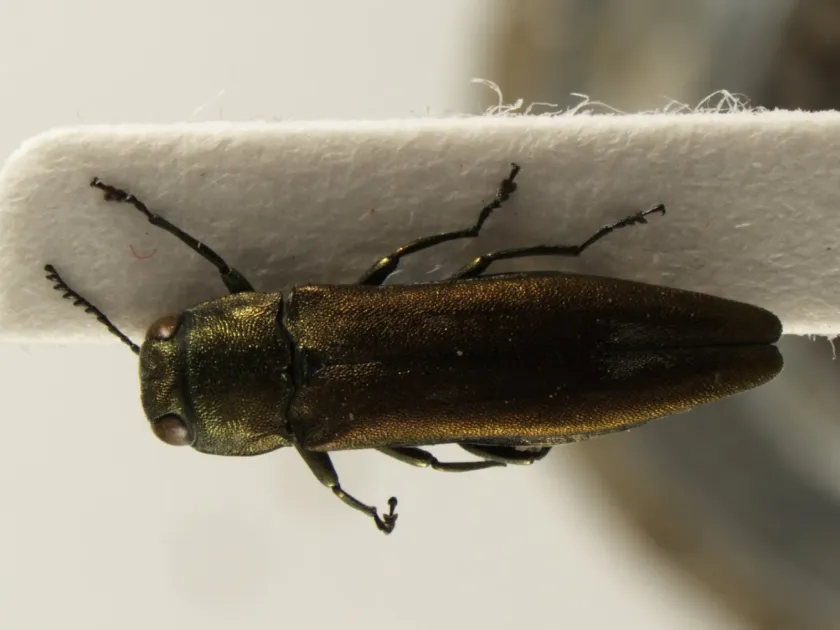
The apple flatheaded borer (Agrilus mali) is a member of the Buprestidae family in the order Coleoptera. The adult beetle is a small insect, typically 5–8 mm long, characterized by a metallic bronze-green or copper-red shimmer on its body.
The beetle has a narrow, cylindrical, and elongated shape. Its larvae are white or cream-colored, legless, and possess a flattened, widened prothorax, growing up to 15–20 mm in length. The pupa has a whitish appearance and resembles the shape of the adult beetle.
Adult beetles are highly active on sunny days, demonstrating agility in flight between trees. The reproduction phase occurs in summer, during which females deposit their eggs into crevices or mechanical wounds on the tree bark.
The primary damage is caused by the larvae, which live and feed beneath the bark. Due to their cryptic lifestyle, early detection is difficult, requiring persistent and diligent inspection of the orchard during the growing season.
The duration of the life cycle varies, typically lasting one or two years depending on local climatic conditions and regional temperatures that influence the rate of larval development.
What it damages
The apple tree is the primary host for Agrilus mali; however, the pest also attacks other Rosaceae species, including pear, plum, apricot, and hawthorn. Severe infestations can lead to the rapid decline and death of the host trees.
Larvae feed on the cambium layer by creating winding galleries, which disrupt the flow of nutrients and water. This obstruction eventually leads to the wilting of branches and can girdle the trunk, causing the entire tree to die.
Damage caused by the borer often provides entry points for secondary pathogens, such as black rot or cytospora canker, which further compromise the tree's health and shorten its productive lifespan.
Trees that are already stressed by drought, poor nutrition, or previous mechanical injury are significantly more susceptible to successful colonization by the flatheaded borer.
The economic impact involves not only immediate crop losses but also the labor-intensive removal and replacement of mature trees, posing a serious challenge to commercial and home orchardists.
When it appears
The flight period for adult beetles usually begins in late May and extends through mid-July. This timing coincides with the tree's most active growth phase, which is when females seek suitable egg-laying sites.
Upon hatching, larvae immediately bore into the bark, establishing the galleries where they feed throughout the summer. As the season progresses, these galleries increase in length and complexity.
Larvae overwinter in specially constructed chambers within the wood or under the bark. As temperatures rise in spring, they complete their pupation, and new adults emerge by chewing characteristic D-shaped exit holes.
In warmer southern regions, the insect typically completes its life cycle in a single year. In contrast, colder northern areas may see the cycle span two years, as larval development slows significantly during winter.
Monitoring efforts should focus on identifying adult beetles during the late spring, utilizing visual inspections or pheromone traps to time protective spray applications effectively.
Signs of infestation
The most reliable sign of an infestation is the presence of D-shaped exit holes on the trunks and major branches, left behind by adults emerging after pupation.
Detailed inspections may reveal areas of necrotic tissue, bark cracking, or localized swelling of the trunk. In areas with high larval activity, the bark may begin to peel or separate from the wood.
The gradual wilting of the canopy, where individual branches exhibit yellowing leaves and premature shedding, often indicates that internal nutrient circulation is blocked by larval galleries.
Removing a section of suspected bark will expose the winding galleries packed with frass (larval excrement and wood shavings), confirming the presence of Agrilus mali larvae.
In stone fruit trees, excessive sap flow or gummosis near the infested areas is another common indicator that the tree is reacting to the physical destruction of its internal vascular tissues.
Control measures
Cultural control is the first line of defense: maintaining orchard vigor through proper pruning, irrigation, and fertilization makes trees more resistant to successful larval establishment.
Sanitation is critical; all infested wood must be removed and destroyed by burning to eliminate overwintering larvae and prevent the emergence of new adult beetles.
Chemical control involves targeting adult beetles with systemic insecticides during their peak flight period. Timing is essential to ensure that larvae are intercepted before they penetrate deep into the bark.
Whitewashing tree trunks with an insecticidal lime solution can serve as a deterrent, discouraging females from landing on the trunk to lay eggs, particularly on young trees.
- Regular monitoring of bark condition.
- Manual removal of larvae in small, localized infections.
- Application of traps to reduce adult populations.
- Encouraging natural predators such as woodpeckers and parasitic wasps.
Taxonomy
- Latin name
- Agrilus mali
- Order
- Coleoptera (beetles)
- Family
- Buprestidae
- EPPO code
- AGRLMA
Discussion
No discussions yet — be the first.