
Agrilus carpini
Agrilus carpini
Description
How to identify
Agrilus carpini is a species of jewel beetle (Buprestidae) in the order Coleoptera. It is a wood-boring insect that is primarily known for its association with hornbeam trees.
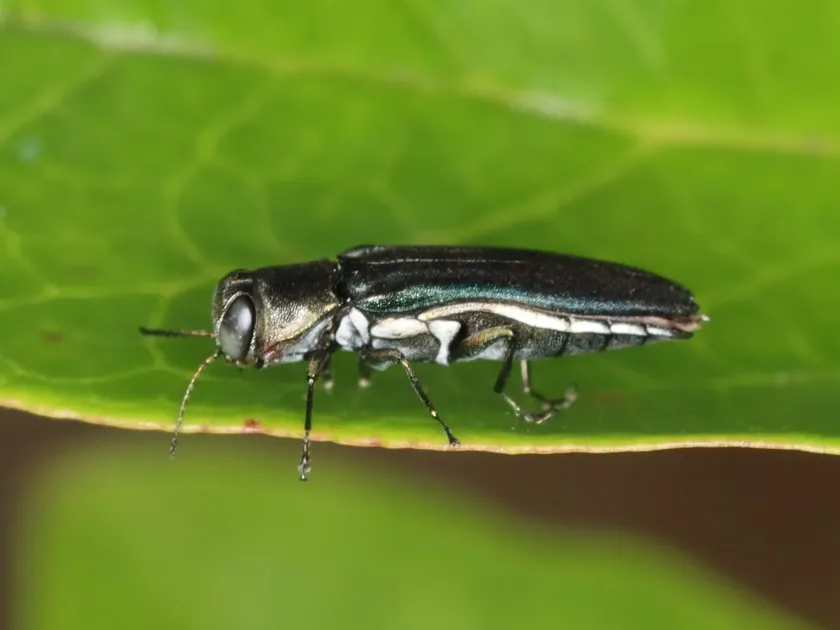
The adult beetle is small, usually measuring 5–7 mm in length. Its body is slender, elongated, and exhibits a characteristic metallic luster, often appearing bronze or greenish.
The larvae are typically white or yellowish, legless, and have a flattened thorax, which is a common morphological feature for the genus Agrilus.
The head of the larva is small and retracted into the prothorax, equipped with strong mandibles designed for chewing through bark and soft wood layers.
The pupae develop inside the wood, where they undergo metamorphosis before emerging as adults through characteristic exit holes on the bark.
What it damages
The primary host for Agrilus carpini is the common hornbeam (Carpinus betulus). It may occasionally infest related species if the host trees are stressed.
Damage is caused by the larvae, which feed under the bark, excavating galleries in the cambium layer. This disrupts the tree's vascular system, hindering the transport of nutrients and water.
Severe infestations can lead to the wilting and dieback of branches, and in cases of extreme density, the death of the entire tree occurs due to girdling.
Young trees are particularly vulnerable, as the larval galleries can easily compromise the structural integrity and health of smaller stems.
The adult beetles feed on the leaves of the host tree, but this leaf damage is generally negligible compared to the destruction caused by the larvae in the trunk.
When it appears
The flight period of adult Agrilus carpini typically occurs during late spring and early summer, primarily between May and June.
During this period, adults emerge from the bark, feed on foliage, and mate. Shortly after, the females lay their eggs in cracks and crevices on the bark of suitable hosts.
Upon hatching, the young larvae bore directly into the phloem and cambium. They spend the remainder of the summer and the following autumn developing in these galleries.
Overwintering occurs at the larval stage within the wood. The larvae remain inactive during the colder months, resuming activity or preparing to pupate as temperatures rise.
The pupal stage is relatively short and occurs within a prepared chamber in the wood during the following spring, just before the new generation of adults emerges.
Signs of infestation
The most reliable sign of an Agrilus carpini infestation is the presence of small, D-shaped exit holes on the bark surface where adults have emerged.
Peeling back small sections of the bark on affected trees reveals winding, zigzagging larval galleries filled with frass, which are diagnostic for this species.
Crown symptoms include the yellowing, wilting, and premature dropping of leaves, often starting from the top or on individual, heavily infested branches.
In cases of long-term infestation, the bark might show signs of cracking, sunken patches, or localized swelling as the tree attempts to heal its wounds.
- Small D-shaped exit holes on the bark.
- Dieback of the crown or specific branches.
- Winding larval galleries filled with frass under the bark.
- Premature yellowing of leaves in summer.
- Bark cracks and necrotic areas on the trunk.
Control measures
Sanitation is the most effective management approach. This involves identifying, removing, and properly disposing of heavily infested trees to reduce the population.
Maintaining high tree vigor through proper irrigation and soil management is essential, as healthy trees are less attractive and more resistant to borer attacks.
In nursery or landscape settings, systemic insecticide applications applied to the trunk during the adult flight period can help prevent females from laying eggs.
Biological control plays a significant role; woodpeckers and various parasitoid wasps are natural enemies that help keep beetle populations in check in forests.
Regular forest health monitoring during the spring and early summer is crucial for early detection, which allows for timely intervention before an outbreak spreads.
Taxonomy
- Latin name
- Agrilus carpini
- Order
- Coleoptera (beetles)
- Family
- Buprestidae
- EPPO code
- AGRLBC
Discussion
No discussions yet — be the first.