

Pest · Hemiptera (bugs, aphids, leafhoppers) · affects Alfalfa, Winter wheat, Winter rapeseed
Alfalfa plant bug
Adelphocoris lineolatus
Description
How to identify
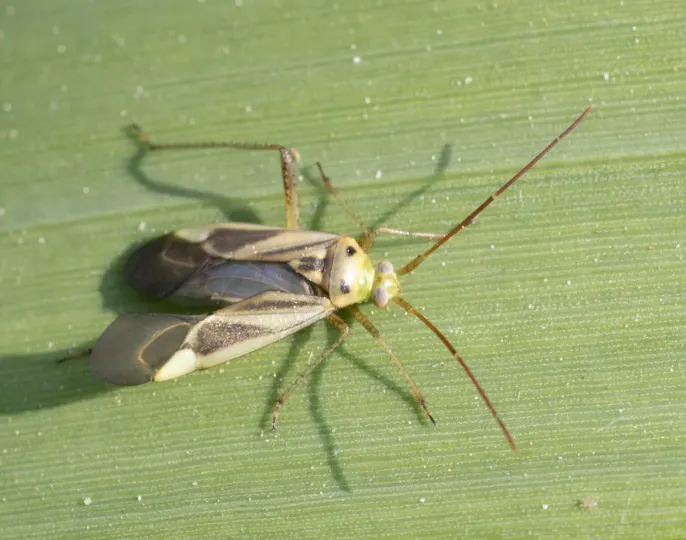
The alfalfa plant bug, scientifically known as Adelphocoris lineolatus, belongs to the Miridae family. Adults typically measure 7 to 9 millimeters in length and display a greenish-yellow to brownish coloration.
A distinctive physical characteristic of this species is the presence of two black spots on the pronotum, which may sometimes merge into a single transverse band. The body is covered in fine, dense hairs, giving the insect a textured appearance.
Eggs are elongated and slightly curved, appearing white or yellowish. Females insert these eggs singly or in clusters into the plant tissues, particularly within stems, which protects them from environmental stressors.
Nymphs go through five distinct developmental stages, resembling smaller, wingless versions of the adults. They exhibit high mobility and begin feeding on plant juices immediately after hatching.
This species overwinters in the egg stage, embedded within plant stems. Development resumes in the spring when temperatures consistently rise, allowing for the emergence of the first generation.
What it damages
While alfalfa is the primary host for this pest, it also infests other leguminous crops such as clover and birdsfoot trefoil. High populations can also result in migration to sunflower or sugar beet fields.
These bugs feed by piercing plant tissues with their mouthparts and extracting cell sap. This process often involves the injection of salivary enzymes that degrade the integrity of plant cells.
The most severe damage occurs when the pest feeds on buds, flowers, and developing pods. This leads to flower blast, where buds turn yellow and fall off before blooming.
Vegetative growth is also compromised; infested plants often show stunted growth, distorted stems, and chlorotic patches on leaves. The total biomass production of forage crops is significantly reduced.
In seed production fields, the damage is particularly critical as the feeding activity results in empty pods, causing substantial yield losses for farmers.
When it appears
The first generation typically emerges in May, coinciding with the initial growth flush of the season. The population density tends to peak during the warm summer months.
Depending on the climatic zone, the pest completes between one and three generations per year. The second generation is often the most numerous and destructive to mid-season crops.
Adult bugs are highly active during warm, sunny days but tend to hide within the lower canopy during periods of excessive heat or darkness to conserve moisture and energy.
In mid-summer, adults frequently migrate between fields to track the phenological stages of their host plants, specifically searching for fields in the budding or flowering stages.
As autumn approaches, the activity declines, and females focus on laying overwintering eggs. These eggs remain dormant until the following spring, ensuring the pest's survival over winter.
Signs of infestation
The earliest signs of infestation are small white or yellowish stippling marks on the leaves caused by the piercing of the epidermis. These spots later coalesce into necrotic areas.
A major symptom of high pest pressure is the rapid drying and shedding of buds. Plants appear weakened, and their overall development is significantly delayed compared to healthy crops.
- Stippling and necrosis on leaf blades.
- Distortion and curling of terminal shoots.
- Premature dropping of flower buds.
- Presence of adults in sweep net samples.
- Empty or poorly developed seed pods.
If the field has been heavily infested, the flower-bearing branches may appear sparse, with most buds failing to progress to the anthesis stage.
Control measures
Cultural control through timely harvesting is highly effective. Cutting the crop early removes the eggs and nymphs present in the stems, disrupting the pest's lifecycle.
Field sanitation, including the removal of wild host plants and weeds along borders, significantly reduces the local reservoir of the pest population.
When monitoring reveals that populations have exceeded the economic threshold, chemical intervention is required. Thresholds vary by region but usually involve counting individuals per sweep net.
Systemic or contact insecticides are typically employed for control. It is vital to rotate active ingredients to prevent the development of resistance within the bug population.
Applications must be timed to avoid harming beneficial pollinators. Spraying should ideally be conducted during the early morning or late evening when bees are not foraging.
Content graph
Connections · Alfalfa plant bug
Most often together:
Marketplace
Products · 1
Biology
Taxonomy
- Latin name
- Adelphocoris lineolatus
- Order
- Hemiptera (bugs, aphids, leafhoppers)
- Family
- Miridae
- EPPO code
- ADPHLI
Community
Discussion
No discussions yet — be the first.