
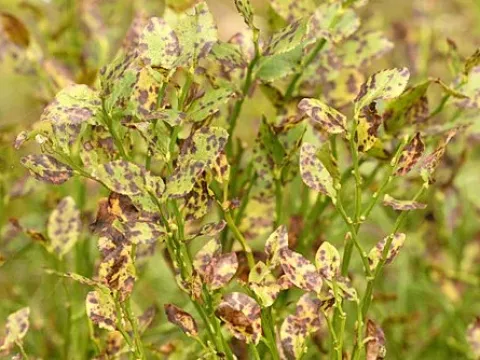
Valdensinia heterodoxa
Valdensinia heterodoxa
Valdensinia heterodoxa is an ascomycete fungus belonging to the order Helotiales. It acts as a specialized plant pathogen capable of causing severe leaf spotting and defoliation in various agricultural and forest species, particularly in the berry industry.
What the section contains
Valdensinia heterodoxa
The fungus is morphologically identified by the presence of distinctive star-shaped conidia that develop on the abaxial surface of infected leaves. These structures serve as the primary diagnostic feature during microscopic examination.
As a member of the Sclerotiniaceae family, Valdensinia heterodoxa utilizes a survival strategy involving the formation of sclerotia. These resting structures are highly resistant to adverse environmental conditions and can persist in soil for several years.
Detection in the field typically involves identifying focal points of infection on the lower canopy. If left unchecked, the pathogen spreads upwards, potentially leading to total leaf loss in affected plantations.
Laboratory diagnosis often requires incubation of symptomatic material in a moist chamber to induce the formation of conidia. The resulting white or grayish sporulation on necrotic lesions is a definitive sign of this pathogen.
The primary hosts for Valdensinia heterodoxa include members of the Ericaceae family, most notably blueberries and wild berries, as well as strawberries. The pathogen targets the leaf tissue, leading to significant necrotic lesion development.
Beyond berry crops, the pathogen has an extensive host range including various herbaceous plants. This polyphagous nature significantly complicates crop rotation strategies on infected land, as the soil often remains infested for extended periods.
The economic damage is primarily caused by the reduction of photosynthetic capacity due to massive defoliation. This weakens the plants, reduces winter hardiness, and prevents the proper development of flower buds, leading to substantial yield losses.
Under heavy infection, plants lose their leaves prematurely, which leads to metabolic stress. This prevents the storage of carbohydrates necessary for winter survival, often resulting in cold injury or plant mortality during the following winter season.
In commercial agriculture, the pathogen can also infect young shoots, leading to stunted growth and structural deformation. This compromises the overall health of the bushes and significantly impacts product marketability.
The life cycle of the pathogen is highly dependent on environmental conditions, specifically high humidity and moderate temperatures. Initial infection usually occurs in late spring or early summer, following the first seasonal rains.
Conidia are dispersed primarily through water droplets, such as rain splash or heavy dew. Dense canopy structures provide the high-humidity microclimate required for the fungus to replicate and spread throughout the plantation.
During a single growing season, multiple secondary infection cycles can occur. This rapid cycling ensures that inoculum levels build up significantly by the end of the summer, intensifying the damage.
The fungus overwinters as sclerotia within the debris of fallen leaves on the soil surface. These structures remain dormant during winter and are triggered by the return of warm, wet conditions in the following spring.
Springtime warming and precipitation initiate the germination of sclerotia, which then infect the lower leaves of the host plants, restarting the cycle of infestation for the new season.
The earliest symptoms appear as small, circular, or irregular lesions on the leaves. Over time, these lesions expand and develop a characteristic brown necrotic center surrounded by a darker, defined margin.
A hallmark sign is the «star-shaped» tissue rupture. As the infection progresses, the center of the lesion often tears away, giving the leaf an appearance similar to insect damage, which is a key diagnostic observation.
On the undersides of the leaves, the pathogen develops a dense, white-to-grayish sporulation layer. This growth is composed of conidiophores and conidia and is highly visible under high-humidity conditions.
As the disease progresses, these individual spots coalesce, covering large sections of the leaf blade. This causes the leaves to curl, turn yellow, and ultimately abscise prematurely, leaving the stems bare.
Distinguishing these symptoms from other foliar pathogens involves noting the rapid expansion of lesions and the unique structural damage to the leaf tissue, which is distinctly characteristic of Valdensinia heterodoxa.
Sanitation is the most critical control measure. This includes the thorough removal and destruction of all fallen leaf litter, which acts as the primary reservoir for overwintering sclerotia and future inoculum.
Cultural management focuses on improving air circulation within the canopy. Pruning and wide-spacing planting schemes reduce humidity levels, creating an environment that is less favorable for fungal growth and spore dispersal.
Chemical control is most effective when applied early in the season, before the disease becomes widespread. Preventive applications of copper-based or site-specific systemic fungicides are recommended for high-risk areas.
Selecting appropriate planting sites is essential to minimize disease risk. Avoiding low-lying, poorly drained fields where water stagnates helps prevent the initiation of the fungal cycle.
Continuous monitoring during the growing season is crucial for successful management. Early detection allows for targeted interventions, preventing the disease from reaching levels that threaten the entire crop yield.