
Ustilina deusta
Ustilina deusta
Description
How to identify
Ustilina deusta (formerly known as Kretzschmaria deusta) is an ascomycete fungus belonging to the Hypoxylaceae family. It is a widespread wood-decay pathogen that forms distinct, hard, crust-like stromata on the bark, which visually resemble charred wood or a layer of coal, hence its common association with burnt appearance.
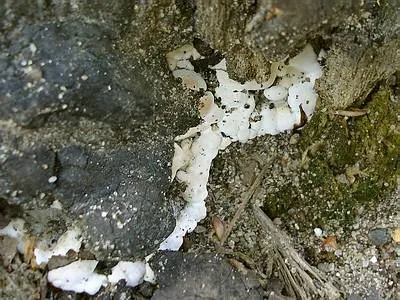
The fruiting bodies of this fungus typically develop at the base of the trunk or on the large structural roots of infected trees. Initially, they display a grayish-white coating due to active conidial production, but they eventually turn black, hard, and acquire an irregular, lumpy surface texture.
This fungus acts as a facultative parasite, transitioning to a saprotrophic lifestyle once the host tree dies. It possesses a high resilience to environmental stressors, primarily due to the dense and durable structure of its stromata.
Microscopic examination reveals the presence of black, hard perithecia embedded within the stroma, which contain the ascospores. These spores are typically spindle-shaped or lemon-shaped with a distinct longitudinal germination slit.
In the field, identification is often aided by observing the state of the wood: it becomes soft, whitish, and brittle, frequently showing characteristic "zone lines" (black demarcation lines) deep within the wood, which separate decayed areas from healthier tissue.
What it damages
The primary hosts of this pathogen are broad-leaved tree species, with a particular prevalence in beech, linden, oak, maple, and chestnut. The fungus impacts both forest stands and trees in managed parks, gardens, and private landscapes.
The infection leads to the development of destructive white wood rot in the roots and the lower trunk, significantly compromising the mechanical integrity of the tree. Decayed wood loses its structure, becoming porous and fragile.
The main danger to plantations is the risk of sudden tree failure, making this pathogen a major safety concern in urban and recreational areas. Infection often gains entry through mechanical wounds in the bark or damage to the root system.
In orchards, Ustilina deusta can infect mature trees, leading to chronic symptoms such as crown thinning, reduced yield, and eventual tree death. The disease progresses slowly, gradually colonizing larger sections of the cambium and heartwood.
Prolonged infection disrupts the tree's vascular system, hindering the transport of water and nutrients from the roots to the canopy. This often results in premature leaf drop, branch dieback, and an overall decline in tree health.
When it appears
Fruiting body development occurs throughout the growing season, with peak activity observed from late spring through autumn. Sporulation is most intensive during periods of high humidity and moderate temperatures.
During the winter, the fungus remains dormant within the decayed wood, maintaining mycelial viability even in freezing conditions. As favorable environmental conditions return in the spring, the fungus resumes its growth and reproductive activity.
The life cycle involves infection via spores dispersed by wind, rain splash, or insect vectors. Upon landing on fresh wounds or exposed wood surfaces, the spore germinates, and the mycelium begins to penetrate the host tissues.
Spore dissemination is highly dependent on humidity levels, which facilitate the rapid germination of conidia on new substrates. While severe droughts may slow fungal activity, they rarely result in the complete eradication of the pathogen from the host.
Secondary transmission between healthy trees often occurs through root grafting, allowing the pathogen to spread efficiently within a stand without requiring external spore dispersal.
Signs of infestation
The most prominent sign is the presence of black, "coal-like" growths on roots and the base of the trunk. In early summer, these growths may appear dusted with a grayish coating, indicating active conidial formation.
Internally, the wood shows significant signs of decay. Cross-sections reveal distinct dark (nearly black) lines known as zone lines, which indicate the boundaries where the fungus has partitioned off sections of the wood.
Chronic infection manifests through crown deterioration. Leaves may appear smaller than normal, yellow prematurely, and exhibit early abscission during the height of the growing season.
In early stages, before visible stromata appear, trees may look healthy to the untrained eye. However, striking the base of the trunk may produce a hollow sound, indicating internal rot and potential structural instability.
Peeling back a portion of the bark on infected areas often reveals a white or cream-colored mycelial mat that colonizes the bark crevices and grows underneath, consuming the cambium and wood tissues.
Control measures
The primary control measure involves sanitary logging and the removal of severely infected trees. It is essential to remove not only the trunk but also the entire root system, as stumps act as a major reservoir for the infection.
Measures should be taken to prevent mechanical damage to trunks and roots during maintenance operations. Any wounds must be promptly treated with appropriate wound dressings or fungicidal agents to prevent spore colonization.
In public parks and urban settings, regular monitoring using instrumental diagnostic methods (such as resistograph testing) is highly recommended for the early detection of internal wood decay.
Chemical control options in forestry are limited due to the scale of infections. An effective integrated management approach involves maintaining biodiversity and reducing environmental stress on trees through proper irrigation and fertilization.
For high-value specimen trees in gardens, surgical removal of infected wood followed by antiseptic treatment may be attempted; however, this is only successful if the disease is identified at an early stage.
Causes diseases · 1
Discussion
No discussions yet — be the first.