
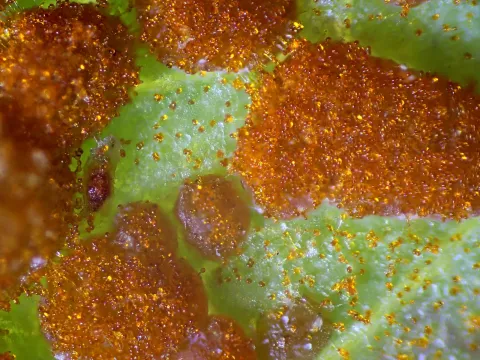
Uromyces coronatus
Uromyces coronatus
Uromyces coronatus is an obligate, specialized parasitic fungus belonging to the Basidiomycota division and the order Pucciniales. It is a known plant pathogen that requires specific hosts to complete its life cycle.
What the section contains
Uromyces coronatus
The mycelium of the fungus develops within the plant tissues, extracting nutrients via haustoria. This pathogen is characterized by its complex life cycle, involving different stages of sporulation.
Taxonomically, it belongs to the genus Uromyces, family Pucciniaceae. The species is distinct due to the morphology of its teliospores, which exhibit a crown-like apex.
The pathogen functions as an obligate biotroph, meaning it must live on a living host to survive and reproduce. Its life cycle involves alternate host species for different spore stages.
Identification typically involves microscopic examination of spore structures, as morphological similarities with other rust fungi make field diagnosis challenging.
The pathogen primarily affects grasses (family Poaceae), including commercial cereal crops like oats and various wild grass species used as forage.
Buckthorn (Frangula species) serves as the primary alternate host, where the fungus completes the initial phase of its life cycle after spring infection.
The fungus causes severe damage by depleting host energy reserves, leading to physiological stress, reduced photosynthesis, and impaired nutrient translocation to the grains.
Significant economic losses occur due to reduced crop yield, lower grain weight, and poor quality of the harvested product, often leading to substantial field failure.
In cases of severe outbreaks, the pathogen causes premature drying and death of the leaf tissue, significantly shortening the plant's productive life cycle.
The infection begins in the early spring on buckthorn leaves, where aecia develop. This primary inoculum serves as the source for secondary spread to grass crops.
During the summer months, under favorable environmental conditions, the fungus spreads via urediniospores, leading to multiple infection cycles and rapid epidemic development.
Fungal proliferation is highly dependent on environmental factors, particularly high humidity and moderate temperatures, which facilitate spore germination and host penetration.
Towards the end of the growing season, teliospores are formed on the grass host. These spores are capable of surviving harsh conditions and serve as the overwintering stage of the pathogen.
The optimal temperature range for the pathogen's growth and spread is between +15°C and +22°C, aligning with the peak growth stages of cereal crops.
The primary symptom on cereal crops is the appearance of pustules, which transition from bright yellow or orange to a dark brown or black color as the pathogen matures.
On the alternate host (buckthorn), the signs include chlorotic leaf spots that develop into orange, cup-like structures known as aecia during the early spring season.
The fungus ruptures the plant's epidermis to release masses of powdery spores, which are then easily dispersed by wind and rain to infect neighboring plants.
Extensive colonization leads to severe leaf yellowing, tissue death, and overall stunting of the plant, often accompanied by the premature senescence of the foliage.
- Chlorotic spots on leaves.
- Formation of orange-colored uredinia (pustules).
- Development of dark-colored telia.
- Leaf deformation and curling.
- Premature death of plant organs.
The most effective strategy involves eradicating buckthorn plants in the vicinity of cereal fields to eliminate the primary reservoir of infection and break the life cycle.
Maintaining spatial isolation between cereal crops and the alternate host is essential to minimize the risk of primary spore inoculation during the spring.
Fungicide application, particularly using triazoles, is recommended upon the first signs of infection to control the spread of the disease within the crop canopy.
The use of resistant cultivars remains the most sustainable and cost-effective approach to mitigate the impact of the pathogen under high-pressure conditions.
Good agricultural practices, including appropriate crop rotation and balanced nutrient management, help improve the overall resilience and immunity of plants against fungal attacks.