
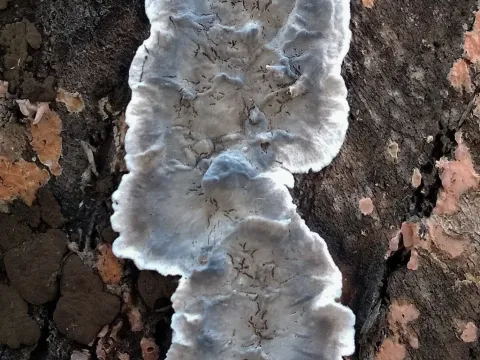
Ustulina deusta
Ustulina deusta
Ustulina deusta (formerly known as Kretzschmaria deusta) is an ascomycete fungus that acts as a serious plant pathogen, causing white rot in woody tissues.
What the section contains
Ustulina deusta
The fungus is commonly known as the brittle cinder fungus. It produces hard, charcoal-like crusts or lumps at the base of infected trees or on exposed roots.
It belongs to the kingdom Fungi and is capable of decomposing lignin and cellulose, which are the main structural components of healthy tree trunks.
The fungus thrives by infiltrating the host plant, weakening its structural integrity to the point where the tree becomes highly unstable.
Recognizing the fungus is often difficult until it produces visible, black, carbonaceous fruiting bodies during its late stage of infection.
It predominantly attacks broadleaf trees, including beech, oak, lime, maple, ash, and various fruit trees such as apple and pear species.
The pathogen induces severe root rot and decay of the lower stem, often leading to sudden tree failure, which poses significant risks in public areas.
Decay caused by this fungus can progress silently for years before the tree shows significant external symptoms of decline or structural weakness.
In forest and orchard environments, the infection leads to the death of trees and the degradation of timber quality, resulting in economic losses.
The loss of structural integrity at the tree base makes the plant highly susceptible to wind-throw, even if the upper crown appears relatively healthy.
Fruiting bodies of the fungus are perennial but show active development and spore release during the spring and summer months under humid conditions.
The spores are disseminated primarily by wind, allowing the pathogen to colonize new hosts throughout the growing season.
The internal decay process initiated by the mycelium occurs continuously throughout the year, as the fungus is well-protected by the host's tissues.
Autumn conditions may lead to more visible growth of the fungal crusts, making it easier for arborists to detect the presence of the pathogen.
During winter, the fungus persists as dormant mycelium within the wood, ready to resume rapid growth as soon as seasonal temperatures rise.
The most diagnostic sign is the presence of brittle, black, undulating, or plate-like fruiting bodies at the base of the trunk or on large roots.
Internally, the wood exhibits a characteristic bleached appearance with distinct black, irregular lines known as zone lines or demarcation lines.
Thinning of the crown, leaf chlorosis, and progressive dieback of branches are indicative of significant root or basal structural impairment.
The bark at the base of the tree may crack or peel away, revealing the white mycelial mat of the fungus underneath the surface.
Hollow sounds detected during arboricultural sounding of the base confirm the existence of severe internal decay caused by the fungal activity.
There are no chemical treatments available to eradicate Ustulina deusta from an infected tree, making proactive management essential for tree health.
Care should be taken to minimize mechanical damage to the root collar and bark during lawn mowing or other maintenance activities.
If the fungus is confirmed, affected trees should be evaluated by a professional arborist to determine the level of hazard and potential for removal.
When removing an infected tree, it is crucial to extract as much of the root system as possible to limit further spread through root grafts.
Sanitation is key; tools used on infected wood must be thoroughly sterilized to prevent the accidental transmission of spores to healthy plant material.