
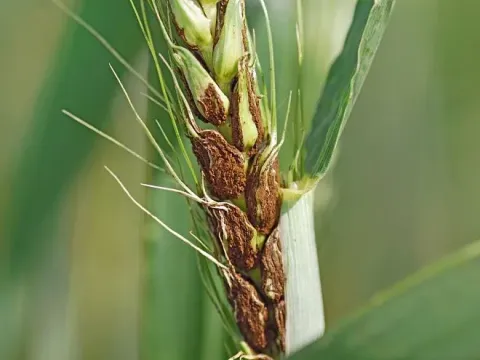
Loose smut of wheat
Ustilago tritici
The causal agent of this disease is the fungus Ustilago tritici, a member of the Basidiomycota phylum. This pathogen is an obligate parasite specifically adapted to wheat and related cereal crops.
What the section contains
Loose smut of wheat
The fungus survives as a dormant mycelium within the embryo of the wheat kernel. It does not manifest externally during the initial stages of germination or vegetative growth, making it a "hidden" threat to crop yields.
Infection occurs during the flowering stage of wheat. Airborne teliospores land on the stigma, germinate, and penetrate the ovary. Once inside, the fungus establishes itself in the developing seed, which remains visually healthy.
When the infected seed is planted, the dormant mycelium reactivates. It grows within the plant tissue, specifically tracking the growth point of the wheat stem, moving upward systemically without causing damage until heading.
At the time of heading, the fungus replaces the entire floral structure with a black, powdery mass of spores. Only the rachis of the spike remains, which is quickly stripped bare as spores are dispersed by the wind.
Loose smut causes significant economic damage by rendering the infected ears completely sterile. Since the grain is replaced by fungal spores, no harvestable yield is produced from these plants.
The presence of the disease in a field leads to both a reduction in grain quantity and a severe decline in seed quality. Infected lots cannot be used for sowing in subsequent seasons without thorough professional treatment.
The severity of the disease is highly dependent on environmental conditions during the flowering phase. Warm and humid weather significantly increases the rate of infection, leading to higher disease pressure in the next season.
While infected plants might look relatively normal in the vegetative stages, they often show reduced vigor or altered morphology that can affect general field uniformity. This makes identification difficult before the ears emerge.
Total yield losses can range from minor to severe, potentially exceeding 20-30% in highly infected fields if proper seed treatments are neglected. It is a critical concern for seed-producing operations worldwide.
The most distinctive sign of loose smut is the transformation of the wheat spike into a mass of black, dusty teliospores. These "smutty" ears appear as soon as the wheat heads emerge from the boot leaf.
Infected plants typically head a few days earlier than healthy ones. Initially, the spore mass is covered by a thin, greyish membrane that ruptures shortly after emergence, exposing the dark spores to wind dispersal.
Once the spores are dispersed, only the bare rachis is left, which stands out as a stark vertical structure compared to the healthy grain-bearing ears. This is a tell-tale sign of the infection in a standing crop.
Although rare, some plants may exhibit subtle changes in color or early senescence, but these symptoms are not specific enough to confirm loose smut without checking the ears. Laboratory diagnostics are required for latent infection testing.
The disease does not spread from plant to plant during the growing season through contact, as the infection is strictly internal and seed-borne. Monitoring during the flowering phase is crucial to assessing the infection potential for the following year.
The primary control strategy is the use of disease-free, certified seeds. Farmers should source their planting material from fields that have passed official field inspections and laboratory checks.
Seed treatment with systemic fungicides is the only effective chemical control method. Because the pathogen is embedded within the seed embryo, contact fungicides are entirely ineffective against this disease.
Effective fungicides typically include active ingredients from the triazole or carboxamide classes, which possess the necessary systemic activity to penetrate the seed tissues and neutralize the mycelium.
Integrated pest management also involves crop rotation and the selection of resistant wheat cultivars. Although loose smut is primarily seed-borne, maintaining diverse rotations helps prevent the accumulation of other soil-borne pathogens.
- Utilizing clean, certified, and disease-tested seed stock.
- Applying systemic fungicides as seed treatments before planting.
- Conducting embryo analysis of seed lots to determine infection rates.
- Selecting resistant or tolerant wheat varieties for high-risk regions.
- Rogueing infected plants early in the season if infestation levels are low.