
Trichoderma harzianum
Trichoderma harzianum
Description
How to identify
Trichoderma harzianum is a fungus belonging to the kingdom Fungi, phylum Ascomycota, and order Hypocreales. While frequently used as a biocontrol agent, certain strains can act as opportunistic pathogens under specific environmental conditions.
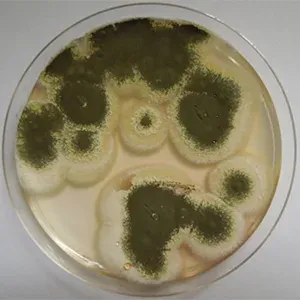
The fungus manifests as a loose, white mycelial growth, which eventually turns green as it produces abundant conidia. The colonies typically display a concentric growth pattern.
Under a microscope, it is identified by branched conidiophores with clusters of phialides. The spores are generally oval, smooth-walled, and easily dispersed by air currents.
As a resilient eukaryotic organism, it thrives on diverse organic substrates. Its life cycle includes both an asexual stage (anamorph) and a sexual stage known as Hypocrea lixii.
Despite its reputation for growth promotion, the fungus possesses enzymatic machinery that can penetrate plant tissues through mechanical wounds or stressed root systems.
What it damages
Trichoderma harzianum affects a wide array of crops, including vegetables, ornamentals, and specialized industrial crops like mushrooms (e.g., white button mushrooms and oyster mushrooms).
In mushroom cultivation, it causes the well-known "green mold" disease, which outcompetes the commercial mycelium, destroys the growing medium, and leads to complete crop failure.
In seedling production, the fungus can induce root rot, causing damping-off, wilting, and subsequent death of young plants, especially when over-watering occurs.
Ornamental bulbous plants are susceptible to rotting of the bulb scales, which can lead to significant losses during both storage and the growing season in high-humidity conditions.
The primary damage occurs through the secretion of cell-wall-degrading enzymes, turning plant tissue into a soft, water-soaked mass that cannot support normal growth.
When it appears
The fungus is most active in high-humidity environments (above 80% relative humidity) with temperatures ranging from +20 to +30 degrees Celsius.
In greenhouse settings and storage facilities, the pathogen can spread year-round if proper aeration, ventilation, and sanitation protocols are not maintained.
Field outbreaks are more common during periods of prolonged rainfall, as excessive moisture weakens the plants and creates a favorable environment for fungal infection.
The conidia are highly resistant to environmental stressors and can survive in the soil or on plant debris for several years.
Transmission occurs through the movement of contaminated tools, infested growing media, or simply through airflow within tight greenhouse compartments.
Signs of infestation
The first indicator of infection is the appearance of a white, cottony mycelial mat on the soil surface or the plant parts.
As the fungus matures, the color shifts from white to a vibrant green, indicating that the fungus has entered its sporulation phase.
- Darkening and softening of the seedling collar.
- A distinct, pungent, musty odor emanating from the soil or growing block.
- Soft rot occurring at the contact point between the plant and the substrate.
- Stunted growth, yellowing foliage, and progressive root system decay.
In mushroom growing blocks, infections appear as patches that expand rapidly, eventually displacing the healthy mycelium of the cultivated mushroom.
Control measures
Strict phytosanitary practices, including the regular disinfection of tools, equipment, and greenhouse surfaces, are the most effective preventive measures.
Maintaining proper airflow and reducing relative humidity through efficient ventilation systems is crucial to preventing the establishment of the fungus.
The use of systemic fungicides as a seed or bulb treatment can help protect young plants from initial infection during the vulnerable early stages of growth.
Avoiding mechanical root injury during transplanting minimizes entry points for the pathogen, as damaged tissues are significantly more susceptible to infection.
Prompt removal and destruction of infected plants or substrate blocks, followed by localized disinfection, are essential to contain the spread of the pathogen.
Causes diseases · 1
Discussion
No discussions yet — be the first.