
Tapinanthus
Tapinanthus
Tapinanthus is a genus of hemiparasitic plants belonging to the family Loranthaceae. These plants are characterized by their inability to obtain water and minerals directly from the soil, forcing them to rely on a host plant's vascular system to survive.
What the section contains
Tapinanthus
The plants attach to the host tree through haustoria, specialized root-like structures that penetrate the bark and connect directly into the host's xylem and phloem. They appear as bushy, evergreen shrubs growing directly from the branches of the host.
Taxonomically, the genus comprises numerous species native primarily to tropical and subtropical African regions. In agricultural science, they are classified as significant phytopathogens due to their competitive nature against fruit and forestry trees.
The life cycle is heavily dependent on birds. Birds consume the sticky fruits and transfer the seeds to the branches of other trees, where they germinate quickly. This dispersal mechanism makes them highly invasive and difficult to contain in open orchards.
Identification is usually straightforward, as the parasitic shrubs exhibit different leaf shapes and textures compared to the host tree's foliage, often creating dense, distinct clusters on the branches.
Tapinanthus causes significant damage by siphoning off water, mineral salts, and photosynthetic products from the host plant. This severe competition leaves the host tree nutrient-deficient and weakened.
The impact is observed on a variety of economically important trees, including citrus, cocoa, and various timber species. Chronic infestation leads to stunted growth, leaf chlorosis, and a drastic reduction in total fruit yield.
As the parasite matures, it often causes branch dieback and increases the tree's susceptibility to secondary infections, such as fungi or wood-boring insects. Heavily infested trees show reduced longevity and are prone to limb breakage.
In addition to nutrient theft, the physical weight of the parasite clusters can place additional stress on branches, especially during wind or heavy rainfall, leading to physical structural damage.
The economic harm is compounded by the fact that Tapinanthus reduces the overall vigor of the plantation, making the trees less resilient to other environmental stressors like drought or pests.
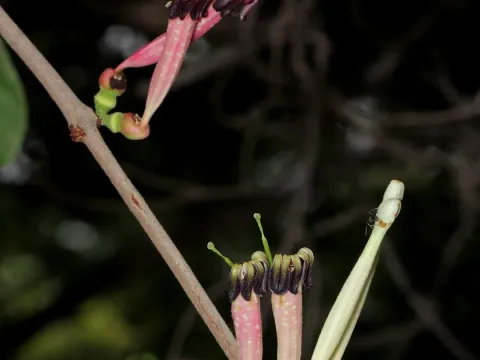
Visual symptoms include the emergence of dense shrub-like clusters on branches that stand out against the natural canopy of the host tree. These clusters are often more vibrant and may have a different growth orientation.
During the flowering stage, the parasite displays distinctive tubular flowers. This is often the most noticeable sign of infection, making it easier to pinpoint the exact locations of the parasites within the orchard.
Host tree symptoms include progressive wilting, yellowing of leaves, and dieback of terminal shoots above the point of attachment. In severe cases, the host tree may appear "dwarfed" or structurally distorted.
At the attachment site, one can observe localized bark swelling or the formation of galls, which are the physical manifestation of the parasite's haustoria embedding into the host's wood.
The presence of bird excrement containing seeds or sticky fruit residues on branches is a strong indicator of recent infestation and highlights active dispersal activity by local bird populations.
Mechanical removal is the primary and most reliable method of control. Pruning affected branches, ensuring that cuts are made well below the haustorial attachment point, is critical to preventing regrowth.
Sanitation practices are essential. All pruned material containing the parasite must be removed from the field and destroyed, preferably by burning, to prevent the spread of seeds by birds.
Regular monitoring of orchards is necessary to detect young seedlings before they develop a deep vascular connection with the host. Early intervention significantly reduces the cost and impact of future control efforts.
While chemical controls are being researched, there are currently few systemic herbicides that can kill Tapinanthus without causing phytotoxicity to the host tree. Thus, emphasis remains on mechanical and cultural management.
Future integrated pest management (IPM) strategies may involve managing bird habitats around plantations to reduce seed dispersal pressure and breeding resistant tree cultivars that are less receptive to haustorial attachment.