
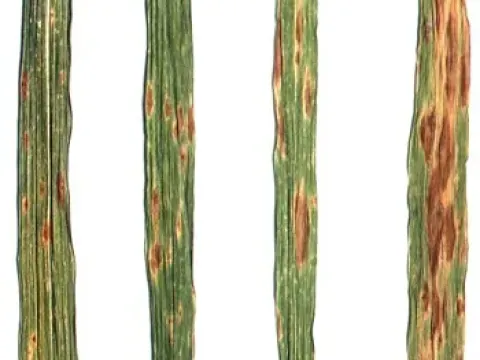
Tan spot of wheat
Pyrenophora trichostoma
Tan spot, also known as yellow leaf spot, is caused by the fungus Pyrenophora tritici-repentis (anamorph Drechslera tritici-repentis). It is a significant foliar disease affecting wheat crops globally.
What the section contains
Tan spot of wheat
This pathogen belongs to the Ascomycota division. It primarily attacks wheat, but can also be found on barley, rye, and various wild grass species that serve as hosts.
The fungus overwinters as pseudothecia on crop residues left on the soil surface. During spring, these structures release ascospores, initiating the primary infection cycle.
During the growing season, asexual spores called conidia are produced. These spores are easily disseminated by wind and rain splashes, leading to rapid spread of the disease within and between fields.
Development is favored by prolonged periods of leaf wetness and moderate temperatures, typically between 15°C and 25°C, which are ideal for fungal sporulation.
The disease causes significant damage by killing leaf tissue, which reduces the plant's capacity for photosynthesis, directly impacting biomass production and grain filling.
Severe infections often lead to premature leaf death, resulting in reduced grain weight, lower test weight, and compromised milling quality of the harvested wheat.
Yield losses can be substantial, often ranging from 10% to 50% depending on the susceptibility of the wheat variety and the environmental conditions during the season.
When the flag leaf is severely damaged, the plant's ability to fill the grain is severely hampered, leading to shriveled kernels and decreased protein content.
Fields practicing minimal tillage or continuous wheat cropping are at higher risk because of the high inoculum load provided by the surface-lying stubble.
Primary infection occurs early in the spring as the crop resumes growth. Ascospores are released from overwintering stubble during rainy weather.
As the season progresses, the disease enters a polycyclic phase, where conidia produced on infected leaves drive the secondary infection cycles through the summer.
The disease is most prevalent and destructive during the stem elongation, booting, and heading stages, as these periods are critical for crop development.
Hot and dry periods can suppress the development of the fungus, but high humidity or rainfall quickly triggers new waves of sporulation and infection.
The cycle completes in the fall when the fungus produces new pseudothecia on the straw, ensuring its survival for the next growing season.
Initial symptoms are characterized by small, tan-colored lesions that are surrounded by a distinct yellow chlorotic halo, giving the disease its name.
As the spots expand, they often become elliptical and turn dark brown. In many cases, these lesions coalesce, covering large parts of the leaf surface.
Under magnification or in later stages, a small dark spot may be visible in the center of the lesion, which indicates the site of initial infection.
The lower leaves are usually the first to show symptoms, with the disease progress moving systematically upward through the plant canopy as conditions allow.
Severe infection leads to general chlorosis and necrosis of the entire leaf, making it difficult for the plant to sustain healthy grain development.
Integrated management is essential. Cultural practices, such as crop rotation and the burial of infected crop residue via tillage, help reduce primary inoculum.
Selecting and planting resistant or tolerant wheat varieties is a highly effective long-term strategy to minimize disease impact without relying on chemicals.
Fungicide applications are the primary method of chemical control. Effective products often include mixtures of triazoles and strobilurins for broad-spectrum protection.
- Avoid continuous wheat planting in high-risk areas.
- Use certified disease-free seeds.
- Time fungicide applications based on crop stage and scouting.
- Optimize nitrogen fertilization to balance growth and disease pressure.
Regular field scouting is critical to detect the disease early, especially during the growth stages where the flag leaf and head protection are paramount.