
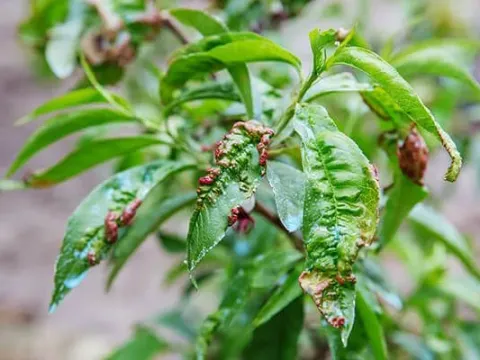
Taphrina deformans
Taphrina deformans
Taphrina deformans is an ascomycete fungus that acts as an obligate plant parasite, causing the well-known peach leaf curl disease. It is a microscopic pathogen that fundamentally alters the host's cellular development.
What the section contains
Taphrina deformans
The fungus survives the winter primarily as blastospores (bud conidia) sheltered within bark crevices and near flower buds. When spring temperatures rise and moisture levels increase, these spores become active.
Infection occurs during the early stages of bud break. Spores penetrate the developing leaves through stomata or directly through the cuticle. Once inside, the fungal mycelium colonizes the intracellular spaces of the leaf tissue.
The fungus produces hormonal substances that induce hyperplastic (excessive cell division) and hypertrophic (cell enlargement) responses in the plant host. This biological manipulation results in the characteristic tissue distortion.
As the season progresses, the fungus produces an ascospore layer on the leaf surface, which appears as a velvet-like coating. These spores are dispersed by rain and wind to settle on bark, completing the disease cycle.
The primary hosts for Taphrina deformans are peach and nectarine trees. While less common, the pathogen can also impact almond and occasionally apricot trees, leading to significant physiological stress.
The disease affects leaves, shoots, and reproductive structures. By damaging the leaf canopy early in the season, the fungus drastically reduces the plant's photosynthetic capacity, causing long-term vigor loss.
Severe infestations lead to massive defoliation, forcing the tree to expend energy reserves to produce a second set of leaves. This weakens the tree, making it susceptible to cold damage and other pests.
Fruit set is often compromised, leading to low yields and unmarketable produce. Infected fruit may show raised, distorted lesions and typically drop prematurely due to the tree's metabolic stress.
Repeated annual infection without control measures can lead to the death of branches and, eventually, the decline and death of the entire tree, causing heavy economic losses for commercial orchards.
The earliest symptom is the appearance of thickened, wrinkled, and blistered leaf areas that turn reddish or purple. This curling makes the leaves appear shriveled and distorted compared to healthy foliage.
A fine, greyish-white, dusty bloom covers the underside or upper surface of the affected leaves; this is the fungal spore-producing layer. Soon after this appearance, the leaves turn yellow and drop from the tree.
Young shoots may become stunted, thickened, and twisted. In cases of chronic infection, the shoots may take on a distorted, club-like appearance or develop into dense clusters known as witches' brooms.
Flowers and fruit are frequently infected; flowers fail to set fruit, while young fruits develop irregular, deformed, and chlorotic patches. Premature fruit drop is a common late-stage indicator of systemic infection.
- Reddish, blistered leaf deformity.
- Presence of a whitish velvet spore layer.
- Stunted and twisted shoot growth.
- Premature defoliation in early summer.
- Deformed fruit with necrotic spots.
The most effective management strategy is a single, thorough fungicide application in late autumn or early spring before bud swell. Timing is critical because the pathogen is inaccessible once inside the leaves.
Copper-based fungicides, such as Bordeaux mixture or fixed copper, are the industry standard for dormant-season control. Some systemic triazole fungicides can also be used during the tight bud stage.
Sanitation practices, such as removing and destroying infected shoots and gathering fallen leaf litter, help reduce the amount of inoculum available for the next growing season, although this is secondary to chemical control.
Planting resistant peach cultivars is the most sustainable approach for long-term orchard management. Resistance breeding has significantly reduced the need for heavy pesticide usage in integrated pest management systems.
Proper orchard maintenance, including adequate nutrition and water, helps trees recover from the stress of infection. Regular pruning of severely damaged branches ensures that the canopy remains open and less humid.