
Tan spot
Pyrenophora tritici-repentis
Tan spot, also known as yellow leaf spot, is a fungal disease caused by the ascomycete Pyrenophora tritici-repentis. The anamorphic stage is identified as Drechslera tritici-repentis.
What the section contains
Tan spot
This pathogen belongs to the kingdom Fungi, phylum Ascomycota. It is a stubble-borne disease that can survive on crop residues in the soil for several seasons.
The fungus primarily targets wheat but can also infect barley, rye, and a variety of wild grasses that act as reservoirs for the inoculum.
The life cycle begins with the formation of pseudothecia on crop debris, releasing ascospores that are dispersed by wind onto young seedlings.
Secondary infections occur through conidia, which are produced on existing lesions during humid conditions, causing multiple disease cycles throughout the growing season.
The damage caused by tan spot results from the destruction of leaf tissue, which drastically reduces the plant's photosynthetic capacity.
The disease leads to a significant decrease in kernel weight and negatively impacts grain quality, including reduced protein content and baking functionality.
In severe cases, yield losses can range from 10% to 50%, depending on the wheat variety's susceptibility and the environmental conditions.
Damage to the flag leaf is particularly detrimental, as it provides the primary energy source for grain filling during the milk-to-dough stages.
In addition to yield reduction, infected crops may have lower bushel weight and overall quality, decreasing their market value.
Infection typically begins in early spring, when temperatures range between +10°C and +12°C and leaf surfaces remain moist for extended periods.
Extended periods of wet, cloudy weather combined with moderate temperatures are ideal for the development and spread of the pathogen.
Symptoms often appear first on the lower leaves of winter wheat and gradually spread to the upper canopy as the season progresses.
The highest levels of infection usually occur during the stem elongation and heading phases, provided that frequent precipitation occurs.
Hot and dry summers may halt the progression of the disease, though the fungus remains dormant in crop debris, waiting for more favorable conditions.
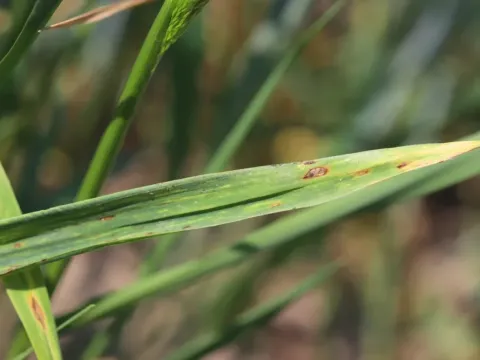
The early signs of the disease appear as small, tan-colored oval spots that gradually enlarge and take on a more distinct brown appearance.
A hallmark characteristic of tan spot is the yellow chlorotic halo surrounding the necrotic spot, which helps distinguish it from other fungal leaf spots.
As the infection progresses, individual lesions merge, covering large portions of the leaf blade, which leads to yellowing and eventual death of the leaf.
A dark, velvety appearance may be visible on the necrotic tissue, which represents the conidial sporulation of the fungus under high humidity.
Severe infection causes premature leaf senescence, starting from the base of the plant, which can result in a scorched appearance of the field.
The most effective management strategy involves the use of crop rotation to break the cycle of residue-borne inoculum and the selection of resistant cultivars.
Deep plowing or mechanical incorporation of crop residue is a vital practice to accelerate the decomposition of infected straw and reduce inoculum pressure.
Fungicides, particularly those containing triazoles or strobilurins, are highly effective at controlling the disease when applied during the growth stages.
Field scouting is essential to determine the timing of fungicide application, typically during the stem elongation or flag leaf emergence phases.
- Use certified disease-free seeds.
- Optimize nitrogen fertilization for crop vigor.
- Control grassy weeds that may harbor the fungus.