
Sugarcane streak
Sugarcane streak
The disease is caused by the Sugarcane streak virus (SSV), a member of the genus Mastrevirus, family Geminiviridae. This pathogen possesses a single-stranded DNA genome.
What the section contains
Sugarcane streak
Transmission occurs exclusively via specific insect vectors, primarily leafhoppers belonging to the Cicadulina genus. The virus replicates within the insect before it can infect healthy plants.
The virus is systemic, meaning it spreads throughout the plant's vascular system, causing long-term physiological stress to the host.
Wild grasses often serve as asymptomatic or latent reservoirs, facilitating the survival of the virus during periods when sugarcane is not actively growing.
Identification is primarily based on characteristic symptoms, but diagnostic tools such as ELISA and molecular techniques (PCR) are required for definitive viral detection.
Sugarcane is the primary host, but the virus is also known to infect other important crops, including maize, millet, and various forage grasses.
The virus disrupts photosynthesis by inhibiting chloroplast development and damaging leaf tissue, which leads to reduced biomass accumulation.
Severe infection during early growth stages results in stunted plants, lower stalk density, and significantly reduced sugar content in the harvested stems.
Economic losses are cumulative, as infected plants remain poor producers throughout the entire growth cycle until harvest.
The spread of the virus within a plantation can result in significant gaps and uneven crop stands, negatively impacting harvest logistics and yields.
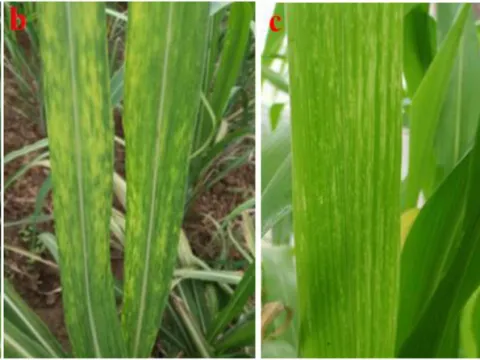
The most diagnostic feature of the disease is the development of narrow, pale-yellow chlorotic streaks that run parallel to the leaf veins.
These streaks can be continuous or broken, often forming a distinct pattern across the leaf surface as the disease progresses.
Infected plants may exhibit reduced growth vigor and, in susceptible varieties, a distinct yellowing of the foliage.
Leaves may become deformed, and the overall plant height is usually reduced compared to healthy, uninfected sugarcane plants in the same field.
- Linear chlorotic streaks along veins.
- Interveinal yellowing.
- Stunted plant growth.
- Leaf deformation in severe cases.
The deployment of resistant cultivars is the most effective and sustainable strategy for managing the virus and preventing yield losses.
Effective weed management is essential to remove wild grass reservoirs that host the leafhopper vectors and the virus itself.
Monitoring and managing leafhopper populations through timely insecticide application can reduce the primary and secondary spread of the infection.
Optimal planting dates and good agronomic practices ensure that plants are vigorous, potentially lessening the severity of viral impact on growth.
Establishing spatial isolation between new sugarcane plantings and older, diseased fields significantly limits the transmission of the virus.