
Sugarcane mosaic
Sugarcane mosaic
The causal agent of the disease is the Sugarcane mosaic virus (SCMV), a member of the Potyvirus genus in the Potyviridae family. It is a single-stranded RNA plant pathogen that infects a wide variety of monocotyledonous crops and grasses.
What the section contains
Sugarcane mosaic
The virus is primarily transmitted in a non-persistent manner by aphids, which carry the pathogen on their stylets after feeding on infected host plants. It can also be spread through mechanical contact or by using contaminated agricultural equipment.
Due to its high genetic variability, the virus frequently adapts to new plant varieties, which poses significant challenges for plant breeding programs. SCMV can persist for long periods in perennial grass weeds, which act as primary infection reservoirs.
Modern laboratory diagnostics, such as ELISA (Enzyme-Linked Immunosorbent Assay) and PCR (Polymerase Chain Reaction), are essential for detecting the virus, especially in early stages when symptoms might be masked or confused with nutritional deficiencies.
The classification of SCMV continues to evolve, with various strains identified based on their aggressiveness and host-specific infectivity, particularly concerning maize hybrids and sugarcane cultivars.
The virus affects a diverse range of crops, including sugarcane, maize, sorghum, and pearl millet. Wild grasses such as couch grass (Elymus repens) and foxtail (Setaria spp.) serve as critical overwintering reservoirs for the virus.
In maize, SCMV infection results in significant yield losses in both grain and biomass. The most severe impacts occur when plants are infected during early growth stages, leading to stunted development and occasionally plant death.
In sugarcane, the virus causes leaf chlorosis, which impairs photosynthesis and reduces sucrose accumulation in the stems. This negatively impacts the quality and sugar extraction efficiency at processing plants.
The damage is often exacerbated by mixed infections with other viral pathogens, resulting in severe leaf deformation and poorly developed ears or tassels. Stressed plants become more susceptible to environmental extremes and secondary biotic threats.
Economic losses are driven by reduced commodity quality, the need for more expensive resistant hybrids, and the recurring costs associated with disease monitoring and sanitation efforts.
The spread of the infection typically peaks during the spring and summer months, coinciding with the migration and activity of aphid vectors. Warm temperatures and moderate humidity levels promote rapid reproduction of these insect vectors.
Initial infection foci appear in fields after aphids migrate from infected perennial weeds or overwintering crops. Once established, the virus spreads further across the field through subsequent migrations of winged aphids.
The rate of disease progression is strongly correlated with aphid population density and the proximity of initial inoculum sources. Temperatures exceeding 20-25°C facilitate faster viral replication within plant cells.
By the end of the season, the development of new symptoms may slow due to physiological aging of the plant, but the virus has already compromised the plant's metabolic processes. The virus then retreats into the roots of perennial grasses to survive the winter.
Field distribution of the disease is typically patchy, reflecting the initial colonization sites of aphid vectors, which subsequently expand as the aphid population moves across the field during the growing season.
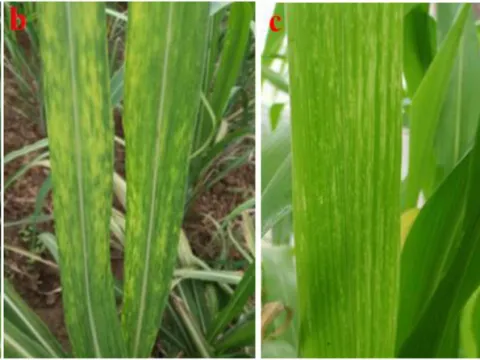
The primary symptom is the emergence of light green or yellowish spots and stripes on the leaves, creating a characteristic mosaic pattern. These stripes usually align parallel to the leaf veins, giving the foliage a streaked appearance.
Infected plants exhibit general growth suppression, shortened internodes, and visible deformation of the leaf blades. In advanced cases, leaf margins may curl, and necrotic areas may develop in the most severely affected tissues.
- Mosaic-like chlorosis (yellowing) on leaves.
- Parallel light-colored striping along veins.
- Deformation and curling of leaf margins.
- General stunting of the entire plant.
- Poor development of reproductive organs (ears/tassels).
In the early stages, symptoms on seedlings may be subtle, but as temperatures rise and plant metabolism accelerates, the mosaic signs become more pronounced and spread across the entire aerial part of the plant.
It is crucial to distinguish this viral mosaic from micronutrient deficiencies, particularly iron or magnesium deficiency, as nutritional disorders often manifest more symmetrically and without the typical leaf twisting or distortion.
The most effective strategy for managing SCMV is the use of genetically resistant or tolerant hybrids and cultivars. This approach is sustainable and eliminates the need for reactive interventions during the growing season.
Effective weed management, particularly targeting grass weeds, is vital to eliminate "green bridges" that harbor the virus during the off-season. Removing couch grass and foxtail near field borders significantly reduces the primary infection risk.
Insecticide applications to control aphids are generally justified only during peak vector migration; however, they are often insufficient to halt the spread because the virus can be transmitted within seconds of aphid feeding.
Maintaining spatial isolation between susceptible crops and known viral reservoirs is a key prophylactic measure. Adjusting planting dates to ensure that crops pass through their most vulnerable stages before peak vector activity can also mitigate risks.
Sanitation practices, such as roguing and destroying individual plants showing primary infection symptoms early in the season, can help contain the virus and prevent it from becoming a widespread field epidemic.