
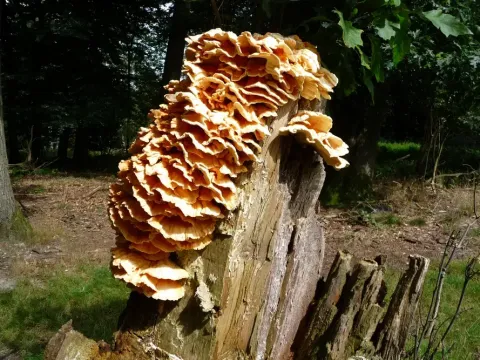
Sulphur polypore
Laetiporus sulphureus
The sulphur polypore (Laetiporus sulphureus), also known as the chicken of the woods, is a widespread basidiomycete fungus. It is a facultative parasite that primarily acts as a heartwood-decaying agent in various deciduous tree species.
What the section contains
Sulphur polypore
Identifying this fungus is relatively easy during its growing season due to its vibrant appearance. The fruiting bodies are fan-shaped, sulphur-yellow to bright orange, and grow in overlapping clusters on tree trunks and stumps.
Taxonomically, it belongs to the Polyporaceae family. Unlike other fungi that slowly decompose dead matter, this species can actively invade living wood by entering through wounds, pruning cuts, or frost cracks in the bark.
The fungus propagates through basidiospores dispersed by wind. Once a spore lands on a vulnerable area of a tree, it germinates and develops a mycelium that spreads throughout the xylem, feeding on the tree's internal structure.
The lifecycle is highly dependent on humidity and temperature. Once established, the mycelium remains dormant in adverse conditions and thrives in spring and autumn, expanding the internal decay of the host tree year after year.
This pathogen targets a wide range of hosts, including oak, willow, cherry, apple, and pear trees. It causes brown heart rot, which significantly compromises the structural integrity of the wood.
The fungus breaks down cellulose, leaving the lignin behind, which leads to the wood becoming brittle and prone to crumbling. This results in the loss of mechanical strength, making trees dangerous due to potential branch or trunk failure.
As the rot progresses, the tree's ability to transport water and nutrients is hindered. This causes gradual crown thinning, stunted growth, and eventually, the complete decline of the tree's health.
Economically, the impact is significant in orchards and urban forestry, as it leads to the loss of mature, high-producing trees. Infected trees often become hazardous to nearby structures and people.
- Significant loss of structural wood stability.
- Reduced fruit production and tree vigor.
- Increased susceptibility to secondary pests and pathogens.
The most obvious sign of an infection is the emergence of bright yellow, fleshy fruiting bodies during the late spring or summer. Their presence is a clear indicator of advanced internal wood decay.
Prior to the appearance of fruiting bodies, the bark might show localized dead patches or vertical cracks. These areas are often soft to the touch and indicate where the fungus has breached the tree's defenses.
The tree's canopy often shows symptoms of distress, such as chlorosis, leaf wilting, or dieback of terminal branches. These signs suggest that the internal root or trunk system is failing to sustain the tree.
A hollow or dull sound when tapping the trunk indicates the presence of extensive internal cavities caused by the fungal activity. This is a critical stage where the tree is at high risk of sudden breakage.
In later stages, the wood surrounding the infected area may become discolored and soft, sometimes showing a cubical rot pattern characteristic of brown decay fungi.
Management focuses on preventing the entry of spores through effective wound management. All pruning cuts and physical injuries must be treated immediately with antiseptic wound paints or copper-based fungicides.
Routine inspection of the garden or orchard is essential to catch early signs of infection. If a tree is found with fruiting bodies, the infected wood should be pruned if localized, though this rarely stops the infection once deep-seated.
Infected fruiting bodies should be collected and destroyed (burned) to prevent the release of billions of spores into the air, which could potentially infect other nearby healthy trees.
For highly infected trees, removal is often the only viable management strategy to protect surrounding vegetation. The root system should also be monitored to ensure the mycelium does not spread through root contact.
Promoting overall tree health through proper fertilization, irrigation, and avoiding site compaction can boost a tree's natural defense mechanisms against fungal pathogens like Laetiporus sulphureus.