
Rotylenchus robustus
Rotylenchus robustus
Rotylenchus robustus is a plant-parasitic nematode belonging to the phylum Nematoda. It is a microscopic soil-dwelling organism that leads an ectoparasitic lifestyle, feeding on plant root cells.
What the section contains
Rotylenchus robustus
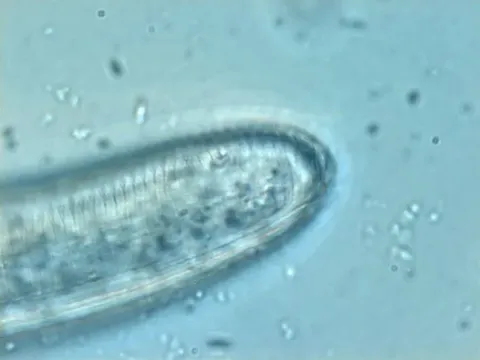
Adults reach a length of approximately 1.2–1.6 mm. Their body has a characteristic worm-like shape, slightly curved when fixed. A key diagnostic feature is the presence of a powerful stylet, adapted for piercing plant tissues.
Systematically, this species belongs to the family Hoplolaimidae. Identification of the species in laboratory conditions requires special microscopic analysis, as the morphological traits of many representatives of the genus Rotylenchus are extremely similar.
The development of the nematode occurs in the soil or the surface layers of the root system. Movement through soil capillaries requires specific moisture levels, making their activity directly dependent on the state of their habitat.
The population of the species includes both females and males, characteristic of an amphimictic mode of reproduction. The life cycle includes an egg stage, four larval stages, and an adult stage.
Rotylenchus robustus infests a wide range of agricultural, ornamental, and vegetable crops. Root crops, cereals, as well as perennial herbaceous plants and tree nurseries are at risk.
The nematode causes the most serious damage to vegetable crops such as carrots, potatoes, onions, and strawberries. In coniferous and deciduous trees, this parasite is capable of causing growth suppression and reduced seedling vitality.
The harm caused by this organism consists of exhausting the host plant's resources. By feeding on the contents of root cells, the nematode deprives the plant of its ability to properly absorb water and nutrients from the soil.
Parasitism contributes to reduced overall yields, deterioration of produce quality, and increases the risk of plants contracting secondary fungal and bacterial infections through wounds inflicted by the stylet.
The danger is particularly high when young roots are damaged, which is critical during the early stages of crop development when the root system is being formed.
The activity of Rotylenchus robustus is directly dependent on soil temperature and moisture levels. Spring and autumn periods with moderate temperatures are most favorable for development.
Nematodes are capable of enduring short-term unfavorable conditions by entering a state of reduced activity or waiting out drought periods in the deeper layers of the soil where necessary moisture is preserved.
In temperate climates, the life cycle usually lasts from several weeks to several months, depending on the temperature optimum of a specific region and the availability of a food source.
The spread of the parasite across a field often occurs through infected planting material, soil particles adhering to agricultural machinery, and via rainwater or irrigation.
Optimal conditions for high nematode concentrations are observed in sandy and loamy soils with good aeration, where it is easier for them to move between soil particles.
The first sign of infestation is localized stunting of plants. Infected areas in a field appear suppressed and often exhibit symptoms of chlorosis due to disrupted nutrition.
Upon careful inspection of the root system, necrotic spots or general root darkening can be observed. Heavily damaged roots become brittle, and their growth slows down, leading to the formation of "bearded" or deformed root vegetables.
Decreased turgor and wilting during daylight hours, despite sufficient soil moisture, are characteristic indirect signs of nematode damage to the root system.
In perennial plants, signs of infestation can accumulate over years, leading to the gradual thinning of plantings, reduced winter hardiness, and susceptibility to environmental stressors.
- Localized yellowing and wilting of leaves.
- Poor development of the root system.
- Reduced yield and deterioration of produce quality.
- Increased sensitivity to other pathogens.
Controlling Rotylenchus is complicated by its ability to survive in the soil for a long time without a host plant. The main emphasis in protection is placed on preventive measures and adherence to good agricultural practices.
The most important method is crop rotation using plants that are poor hosts for this nematode, such as certain cereal species or green manures (mustard, oilseed radish).
Using only healthy, certified planting material prevents the introduction of the pest into new areas. Cleaning agricultural machinery of soil after working in infected fields prevents the spread of the infestation.
The use of fumigants or specialized nematicides is justified only in nursery or greenhouse conditions where the economic threshold of damage is exceeded. In open fields, such measures are often economically unfeasible.
Biological control, including the use of nematophagous fungi or bacteria inhabiting the rhizosphere, is a promising direction, though it requires a systematic approach and regular application of biological agents.