
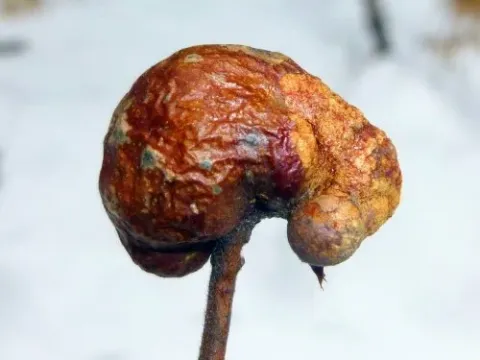
Pucciniastrum goeppertianum
Pucciniastrum goeppertianum
Pucciniastrum goeppertianum is a pathogenic rust fungus that belongs to the division Basidiomycota. It is an obligate parasite with a complex, heteroecious life cycle, meaning it requires two different host species to complete its biological development.
What the section contains
Pucciniastrum goeppertianum
The primary host (aecial host) for this fungus is the spruce (Picea spp.), where it completes its initial development. The secondary hosts (telial hosts) are members of the Ericaceae family, particularly species within the Vaccinium genus, such as blueberries and lingonberries.
The fungus is characterized by systemic infection in its telial host. The mycelium grows perennially within the plant tissues, specifically within the stems and shoots, making it an extremely difficult pathogen to eradicate once established in a planting.
Biological development involves several spore stages, including aeciospores produced on spruce needles and urediniospores/teliospores produced on the stems of berries. The fungus is highly adapted to cool, moist environments where spruce forests are prevalent.
Identification is primarily based on the distinctive morphological changes it induces in the host plants. Mycologists identify the species through microscopic observation of the spore-bearing structures found on the surface of the hypertrophied plant tissues.
The economic impact of Pucciniastrum goeppertianum is felt most significantly in the cultivation of Vaccinium crops. While it frequently infects wild populations, it can also cause serious losses in commercial berry farms located near spruce forests.
The most characteristic damage is the development of "witches' broom," where the infected shoots become stunted, thickened, and densely branched. These deformed stems fail to produce flowers or fruit, effectively reducing the yield of the entire plant.
The infection is systemic and chronic. Once the fungus enters the host, it colonizes the vascular tissues and persists for the lifespan of the branch, continuously drawing nutrients from the plant and hindering its metabolic processes.
Infected plants exhibit reduced winter hardiness and are more prone to secondary infections by other fungi or bacteria. The overall vitality of the bush declines over several years, eventually leading to the death of the specimen if not managed properly.
In regions with high humidity and significant spruce populations, this pathogen can lead to widespread infestation across a plantation, making it a critical concern for integrated pest management programs in northern berry production.
The visual symptoms of the infection are quite unique and easy to distinguish for an experienced agronomist. Infected branches display abnormal hypertrophy, appearing swollen and distorted compared to normal, healthy growth.
During the sporulation stage, the fungus produces orange-colored, dust-like pustules on the infected stems. These pustules are composed of masses of spores that are easily disseminated by wind to nearby spruce trees.
- Formation of dense, broom-like clusters of distorted shoots.
- Swelling and hypertrophy of stems.
- Premature leaf drop and stunted growth.
- Presence of rusty-orange powdery spores on the stem surface.
- Dieback of infected shoots during the dormant season.
The bark of the infected stems often cracks or becomes ruptured as the fungus emerges to release its spores. These ruptures provide pathways for other opportunistic pathogens, which further complicates the health of the infected plant.
The absence of fruit or the presence of malformed fruit on specific branches is a key diagnostic sign that the plant has been colonized systemically by the rust fungus, requiring immediate intervention.
The primary strategy for controlling Pucciniastrum goeppertianum is the spatial separation of berry plantations from spruce-dominated forests. A buffer zone of several hundred meters is recommended to reduce the risk of primary inoculation.
Sanitation is a vital component of control. Growers should perform regular inspections and promptly prune and destroy all infected branches or entire bushes by burning them to ensure the removal of the fungal inoculum from the field.
Fungicide applications may be used preventatively during the period when aeciospores from spruce trees are most active. Products containing copper or modern systemic fungicides can help protect healthy growth from primary infections.
Good cultural practices, such as maintaining proper plant spacing to ensure air circulation, are essential. Lowering humidity levels within the canopy significantly hinders the ability of the fungal spores to germinate and infect new tissue.
Continuous monitoring and early detection are crucial. Because the fungus is systemic, removing the entire plant is often the most effective way to protect the rest of the plantation, as partially infected plants act as a permanent reservoir for the disease.