
Pucciniastrum americanum
Pucciniastrum americanum
Description
How to identify
Pucciniastrum americanum is a specialized fungal pathogen belonging to the Basidiomycota division. It is a heteroecious rust fungus that requires two biologically distinct plant hosts to complete its complex life cycle.
The primary host for this pathogen during the summer months is the red raspberry (Rubus idaeus). The second stage of the fungus's development, necessary for the formation of aeciospores, occurs on spruce trees (Picea spp.), where the pathogen overwinters as mycelium in the needles.
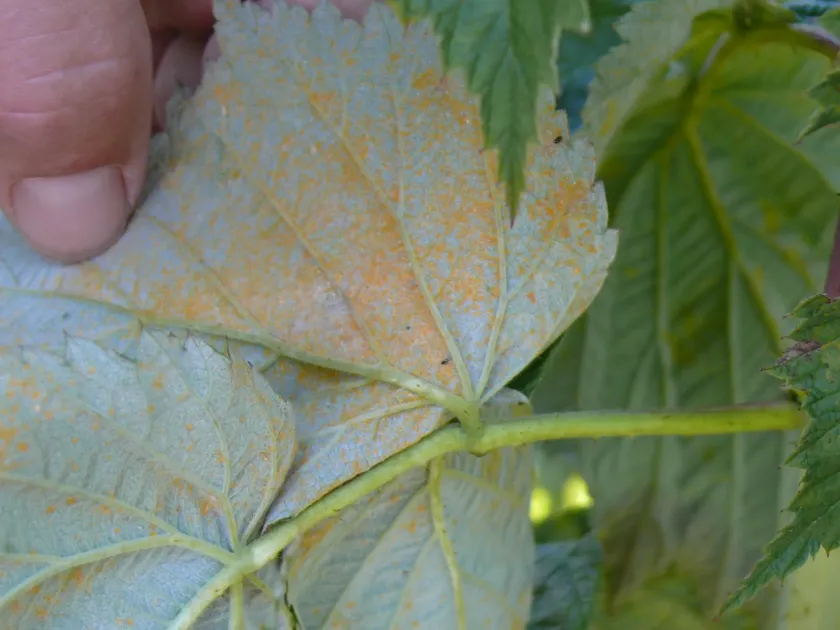
Morphologically, the fungus is characterized by the formation of specific structures known as uredinia and telia on the undersides of raspberry leaves. Urediniospores have a distinct shape and ensure the massive spread of the infection throughout the growing season.
Systematically, this species belongs to the order Pucciniales. Its hallmark is a high degree of specialization on members of the genus Rubus, which makes management challenging when spruce plantings are nearby.
Microscopic analysis allows for the accurate identification of the species based on spore morphology, which are produced in vast quantities under favorable moisture and temperature conditions.
What it damages
The main targets of infection are raspberries and certain species of blackberries. The fungus primarily attacks the foliage, disrupting photosynthetic processes and reducing plant vigor.
On infected plants, berries and young canes may also be damaged, significantly reducing the marketability of the harvest. Infection on fruit manifests as a characteristic rusty powder, rendering the berries unsuitable for sale.
Severe leaf infection leads to premature drying and defoliation, which weakens the plant before the winter dormancy. This reduces the overall cold hardiness of the raspberry bushes and decreases productivity in the following year.
Infected bushes serve as a source of inoculum for neighboring plantings, contributing to the rapid spread of the rust across the entire field within a single season.
Yield losses can reach significant levels if control measures are not implemented, particularly in years with rainy summers, which are highly conducive to fungal sporulation.
When it appears
Primary infection in the spring occurs through aeciospores, which are wind-dispersed from spruce trees to the young shoots and leaves of raspberry plants. This typically coincides with the active growth period of the berry bushes.
During the summer months, secondary infection occurs, driven by urediniospores. This process repeats multiple times, ensuring the potential for an epiphytotic outbreak given frequent rainfall.
The most favorable conditions for the development of Pucciniastrum americanum are moderate temperatures and high atmospheric humidity sustained over long periods.
By autumn, the fungus transitions to the teliospore stage, preparing the pathogen for overwintering. At the end of the growing season, the pathogen retains viability on fallen leaves and spruce needles.
The development cycle is strictly synchronized with the phenological phases of the spruce, as the infection of the new generation of raspberries begins with the aeciospores produced on spruce needles.
Signs of infestation
Small, circular, yellow-orange pustules appear on the undersides of raspberry leaves. These are clusters of urediniospores that are easily disseminated by wind currents.
On the upper surface of the leaf, chlorotic spots often form in the areas of infection. Over time, these spots can undergo necrosis, covering significant areas of the leaf blade.
Infected berries become deformed and covered with a powdery layer of spores, which is a visual indicator of the disease during the fruit ripening period.
When the spruce needles are infected, aecia can be observed—bright yellow growths that become visible in the spring upon careful inspection.
A characteristic sign is the patchy nature of the infection: the bushes closest to the source of inoculum or in areas with poor ventilation are usually the first to be affected.
Control measures
The primary agronomic control method is maintaining spatial isolation between raspberry plantations and spruce plantings, especially the white or Canadian spruce.
It is crucial to perform timely sanitary pruning and the removal of plant debris, as the fungus can persist and remain viable on fallen leaves.
The use of resistant raspberry cultivars remains the most effective long-term strategy for managing the disease.
Application of chemical fungicides (copper-based products or modern systemic fungicides) is effective when applied at the beginning of the growing season or at the first sign of infection.
- Regular pruning to improve air circulation.
- Avoiding overhead irrigation to keep foliage dry.
- Balanced fertilization to improve plant immune response.
Causes diseases · 1
Discussion
No discussions yet — be the first.