
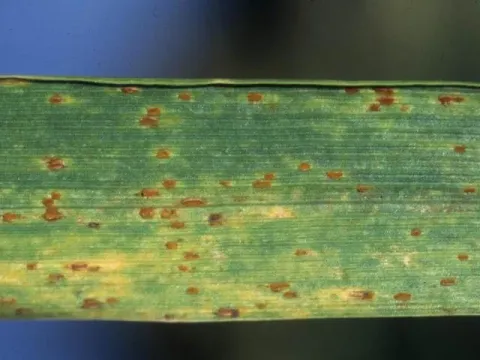
Puccinia canaliculata
Puccinia canaliculata
Puccinia canaliculata is a fungal pathogen classified within the kingdom Fungi, phylum Basidiomycota, class Pucciniomycetes, and genus Puccinia.
What the section contains
Puccinia canaliculata
It is identified as a heteroecious rust fungus, which implies that it requires two taxonomically unrelated host plants to complete its complex biological life cycle.
The organism is characterized by a high degree of specialization, producing distinct types of spores including aeciospores, urediniospores, and teliospores.
These spores are specialized for survival and dispersal, enabling the fungus to propagate effectively across different host populations during the growing season.
Microscopic analysis of the teliospores and uredinial sori is essential for the taxonomic identification of this species in plant pathology research.
The primary host for the aecial stage of Puccinia canaliculata is Ambrosia species, particularly common ragweed, which is a significant agricultural weed.
The telial stage occurs on plants in the family Cyperaceae, specifically the genus Cyperus, such as yellow nutsedge, which is a problematic weed in many crops.
Infection leads to reduced photosynthetic capacity, stunted growth, and a significant decrease in the biomass production of the host plant.
Economic damage occurs when the fungus affects commercially grown species like tiger nuts, causing reduced tuber quality and lower yields.
The pathogen exerts physiological stress on the host, making it more susceptible to environmental extremes and decreasing its competitive ability.
The life cycle begins in early spring when overwintered teliospores germinate and infect the primary host species, such as ragweed.
During the summer months, the production of urediniospores leads to repeating infection cycles, allowing the pathogen to spread rapidly through sedge populations.
Late summer and autumn are characterized by the development of teliospores, which are the resting stage of the fungus designed to survive harsh winter conditions.
Environmental factors, specifically high humidity and moderate temperatures, are critical for the successful infection and spore germination process.
Leaf wetness duration is a key parameter for disease development, making periods of heavy dew or frequent rainfall high-risk intervals for disease spread.
Initial infection on the primary host manifests as bright yellow or orange-colored aecia, which are cluster-like fungal structures on the leaf surfaces.
On sedges, the pathogen creates elongated, channel-like pustules (uredinia) that release rusty-brown powdery spores into the air.
As the disease progresses, these pustules darken, forming black telia, which indicate the final reproductive phase of the fungus on the current host.
- Chlorotic or yellowing spots on foliage
- Powdery rusty-colored spore masses
- Leaf distortion and curling
- Premature necrotic patches on leaves
- Reduced vigor and stunted plant stature
Advanced infections result in a scorched appearance of the foliage, drastically reducing the metabolic productivity of the plant.
Integrated pest management strategies focus on the eradication of alternative hosts, such as ragweed, to break the fungal life cycle.
Fungicides, particularly those belonging to the triazole or strobilurin classes, can be employed to manage severe outbreaks in commercial fields.
Cultural practices, such as removing weeds and destroying crop debris, are effective methods for reducing the primary inoculum source for the next season.
Scouting for early disease symptoms is vital, as early detection allows for targeted control applications before the pathogen reaches epidemic levels.
Understanding the biology of Puccinia canaliculata helps in designing specific control protocols that mitigate its impact on both weeds and crops.