
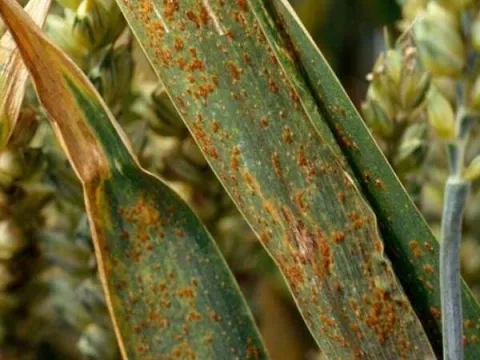
Brown rust of wheat
Puccinia recondita
Brown rust of wheat, caused by the fungus Puccinia recondita (often referred to as Puccinia triticina), is a destructive foliar disease affecting wheat crops worldwide.
What the section contains
Brown rust of wheat
The pathogen is an obligate biotroph, meaning it requires living host tissue to complete its life cycle and survive throughout the growing season.
The fungus produces masses of urediniospores that are easily disseminated by wind currents, allowing the disease to spread rapidly over long distances to adjacent or distant wheat fields.
Environmental conditions favoring the disease include high humidity, moderate temperatures (15–25°C), and the presence of free water on leaf surfaces, such as dew or light rain.
Under optimal conditions, the pathogen's life cycle is very short, often completing a cycle in just over a week, enabling rapid multiplication of the fungus in a field.
Brown rust primarily affects the leaf blades and sheaths of wheat plants, significantly reducing the surface area available for photosynthesis.
The disease limits the plant's ability to produce assimilates necessary for grain filling, leading to shriveled grains, reduced test weight, and lower overall yields.
Severe infections weaken the plant, making it more vulnerable to secondary infections, drought, and lodging, which can cause total yield losses in highly susceptible varieties.
Economic damage is exacerbated by the reduction in both quality and quantity of the harvest, impacting the milling and baking potential of the grain.
Continuous monitoring and early intervention are essential to preventing major outbreaks that can devastate large areas of cereal production.
Initial symptoms consist of small, circular to oval, reddish-brown pustules appearing scattered across the upper surface of the leaves.
As the infection progresses, these pustules coalesce, causing leaves to yellow prematurely and die, giving the canopy a scorched, rusted appearance.
Later in the season, black-colored telia (teliospores) may form, usually arranged in small, dense clusters, often covered by the host epidermis.
The spore masses are powdery in texture and can be easily transferred to fingers or clothing when brushing against an infected plant.
In seedlings, the infection may manifest as reduced vigor, stunted development, and poor tillering, particularly in susceptible cultivars grown in high-humidity regions.
The most sustainable strategy for managing brown rust is the use of genetically resistant or tolerant wheat varieties suited for local environments.
Cultural practices such as destroying volunteer wheat, adjusting sowing dates to avoid peak spore load, and managing nitrogen levels help lower disease pressure.
Fungicide applications are crucial in areas where the disease is endemic, focusing on the protection of the flag leaf during critical stages like boot and heading.
Modern integrated pest management (IPM) programs rely on scouting and disease forecasting models to apply fungicides only when economic thresholds are met.
- Selection of resistant wheat cultivars.
- Timely fungicide application using systemic compounds.
- Control of secondary weed hosts.
- Balanced nutrient management to enhance plant vigor.