
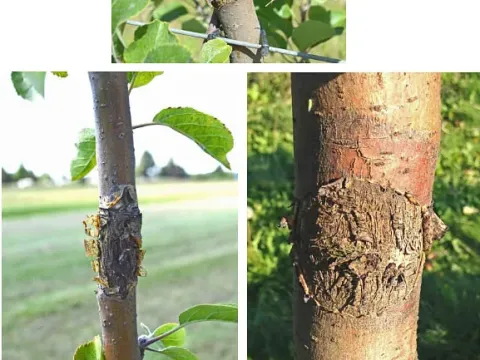
Bull's eye rot
Pezicula malicorticis
Pezicula malicorticis is an ascomycete fungus that acts as a significant pathogen for pome fruit trees. In its scientific classification, it belongs to the Dermateaceae family.
What the section contains
Bull's eye rot
The fungus has a complex life cycle involving both sexual (apothecia) and asexual (conidial) stages, with the latter often referred to as Neofabraea alba.
The pathogen overwinters primarily as mycelium within bark cankers on branches or as infected mummified fruit that remains attached to the tree.
Conidia are the primary dispersal agents, spread effectively by splashing rain and wind currents, which facilitates the rapid movement of spores within the orchard.
It is an opportunistic parasite that thrives by infecting healthy tissue through natural openings like lenticels or existing mechanical injuries on the tree.
The primary hosts of this fungus are apples and pears, where it causes two distinct types of symptoms: bark cankers and fruit rot, commonly known as Bull's eye rot.
Cankers on branches and trunks can lead to vascular disruption, resulting in the dieback of entire branches and significantly reducing the tree's vigor and lifespan.
The most severe economic impact occurs post-harvest, as infections often remain latent in the field and only develop into visible rot after several weeks in storage.
Infected fruit exhibit deep, soft decay that renders them completely unsalable, causing significant losses to both commercial growers and private orchards.
The disease effectively limits the marketability of crops and necessitates expensive sorting and rejection processes during the packing stage.
The development of the fungus is highly dependent on environmental conditions, particularly cool, wet weather, which is common in late summer and autumn.
Optimal conditions for infection include temperatures between 10°C and 20°C combined with high humidity, rainfall, or heavy dew which favors spore germination.
During winter months, the fungus enters a period of dormancy, but it persists within the wood, waiting for favorable conditions to begin active sporulation again.
Primary fruit infection typically occurs in the orchard 2 to 4 weeks before harvest, although the disease symptoms remain hidden until storage periods begin.
Springtime brings the renewal of conidial production on old cankers, which provides the initial inoculum for the new season's foliage and developing fruit.
Bark cankers appear as sunken, discolored patches that eventually crack open, forming prominent, thickened margins as the tree attempts to heal.
On fruit, early symptoms manifest as small brown circular spots that gradually expand, become depressed, and turn soft in the center.
A diagnostic sign of Bull's eye rot is the formation of concentric circles of white or cream-colored pustules within the center of the decayed area.
The flesh of the infected apple becomes soft, often develops a bitter taste, and exhibits a characteristic smell of decomposition as the rot deepens.
Severe infestations on trees can cause extensive bark death, leading to the ringing of branches and eventual structural failure of the affected wood.
The foundational step in management is rigorous sanitation, which includes the removal and burning of infected branches and any mummified fruit during pruning.
Improving orchard ventilation through proper canopy management is essential to reduce humidity levels, making the environment less hospitable to fungal spores.
Fungicide applications, particularly during critical windows of fruit development and pre-harvest, are highly effective at minimizing infection rates.
Applying antiseptic wound dressings after pruning prevents the fungus from colonizing exposed wood and establishing new canker sites.
For harvested fruit, strict adherence to temperature-controlled storage and proper ventilation can significantly delay the onset and spread of rot symptoms.