
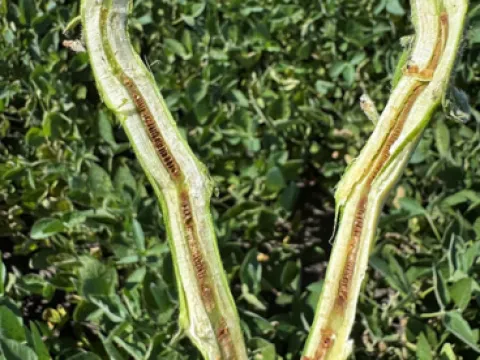
Brown Stem Rot of Soybean
Phialophora gregata
The causal agent of this disease is the fungus Phialophora gregata. It belongs to the Ascomycota phylum and is recognized as a serious vascular pathogen affecting the xylem of soybean plants.
What the section contains
Brown Stem Rot of Soybean
This pathogen is classified as a soil-borne fungus. It survives in the soil and on crop debris, utilizing these as primary inoculum sources to initiate infection in new soybean crops during the growing season.
The primary host for this pathogen is soybean (Glycine max). The disease causes significant vascular damage, leading to internal stem browning and root rot symptoms that weaken the plant structure.
Economic damage is caused by yield reduction through decreased pod filling and stunted plant growth. In severe cases, the infection can cause early lodging and premature plant death, significantly reducing the final harvest weight.
Phialophora gregata thrives in cool to moderate soil temperatures. The infection process typically begins during the early vegetative stages, but symptoms often become visible during the reproductive stages of the soybean plant.
The disease cycle involves the penetration of the root system, followed by the systemic movement of the fungus into the stem. Overwintering occurs through survival structures within infected stubble left in the field after harvest.
External signs are characterized by interveinal chlorosis, which eventually progresses into leaf necrosis. The leaves typically wither while remaining attached to the plant, which is a common visual indicator.
A definitive diagnostic sign is found by splitting the stem longitudinally. A healthy stem is green, whereas an infected stem will show distinct brown discoloration of the internal pith, which is the hallmark of this specific fungal pathogen.
Effective management relies heavily on crop rotation. Avoiding soybean planting for at least three consecutive years helps reduce the pathogen density in the soil, preventing severe outbreaks in subsequent cycles.
- Utilize resistant soybean cultivars.
- Implement tillage practices that speed up crop residue decomposition.
- Avoid early planting in cold, wet soils.
- Use professional seed treatments to protect germinating seeds.
Integrated management is essential, as there are no post-emergence curative fungicides effective against Phialophora gregata once the infection has established itself in the vascular system of the plant.