
Pseudoseptoria leaf spot
Pseudoseptoria donacis
Description
How to identify
The causative agent of the disease is the fungus Pseudoseptoria donacis (syn. Selenophoma donacis), belonging to the division Ascomycota. It is a specialized fungal pathogen primarily affecting reeds (Phragmites australis).
The fungus produces pycnidia, which are submerged, dark-colored fruiting bodies within the leaf tissues. These structures contain sickle-shaped conidia, the primary units of fungal dispersal in favorable environments.
Taxonomically, the fungus is associated with the class Dothideomycetes. It overwinters as mycelium or dormant pycnidia within dead plant debris, ensuring survival from one growing season to the next.
Diagnostic identification requires microscopic examination to confirm the characteristic morphology of the conidia. The genus Pseudoseptoria is well-defined by these specific reproductive structures.
The fungus maintains its population by cycling through both saprophytic and pathogenic phases. Understanding this transition is essential for managing the inoculum pressure in agricultural or natural wetland systems.
What it damages
The main host of Pseudoseptoria donacis is the common reed. The infection causes localized necrosis, which disrupts the host's normal metabolic processes, particularly photosynthesis in the leaves.
As the infection progresses, large sections of the leaf surface become necrotic and dry out. This reduction in photosynthetic area significantly impacts the plant's overall vigor and capacity to store nutrients.
In high-density stands, the disease can lead to extensive foliage loss, which degrades the quality of the biomass. For industrial purposes, such as thatching or pulp production, this results in significant economic loss.
The pathogen can weaken individual stems, making them more susceptible to lodging or stress from secondary environmental factors. Chronic infection may inhibit the development of healthy lateral shoots.
Severe infestations reduce the plant's long-term competitive ability within a community. Over time, persistent outbreaks can lead to a decrease in the density and health of the entire reed bed.
When it appears
Disease development is highly dependent on humidity and rainfall. Periods of prolonged leaf wetness are critical for the germination and penetration of conidia into the host tissue.
Initial infections occur in the spring as temperatures rise, typically between 15°C and 22°C. Spores are splashed by rain or wind-dispersed from overwintered debris onto new green leaves.
The disease cycle can repeat multiple times throughout the summer if the weather remains humid. Each cycle of sporulation leads to secondary infections, potentially causing rapid spread across a field.
Autumn triggers the transition of the pathogen into its overwintering state. By reducing the amount of residual plant material, the potential for early-season outbreaks the following year can be minimized.
Stagnant air and high moisture levels within dense vegetation provide optimal conditions for the fungus to thrive. Proper site management is required to prevent these conditions from persisting.
Signs of infestation
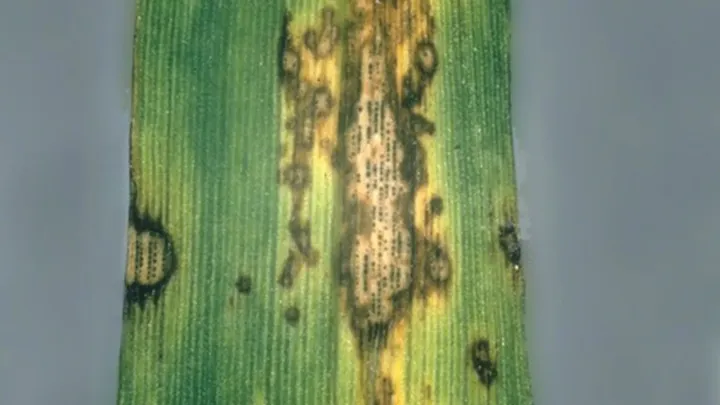
The most distinctive signs are elongated brown or dark grey spots on the leaves. These lesions are often surrounded by a chlorotic halo, indicating the plant's defensive reaction to fungal toxins.
As the lesions mature, small black dots—the pycnidia—become visible to the naked eye within the necrotic tissue. These are key diagnostic features of the infection.
Infected leaves exhibit a blighted appearance, with tips turning yellow and eventually curling. The lesions can coalesce, causing the death of entire leaves prematurely.
High humidity promotes the emergence of spore masses, which may appear as a light, fine coating on the surface of the lesions. This signifies an active stage of pathogen dissemination.
The necrotic pattern often follows the venation of the leaf, resulting in unique, slightly curved shapes that differentiate this disease from other generic leaf spots.
Control measures
Sanitation is the most effective control strategy. Harvesting and burning infected plant debris during the dormant season prevents the fungus from surviving until spring.
Improving air circulation through careful spacing or thinning of reed stands can reduce leaf wetness duration, effectively hindering fungal spore germination.
Where economic thresholds are reached, the application of systemic fungicides can protect high-value crops. These treatments are most effective when applied early in the disease cycle.
Preventing waterlogged soil and optimizing drainage can decrease the overall humidity levels in the microclimate, making the environment less favorable for the pathogen.
Integrated management should prioritize plant health by avoiding excessive nitrogen applications that create succulent tissue. Resistant varieties or populations should be preferred when establishing new plantations.
Causes diseases · 1
Discussion
No discussions yet — be the first.