
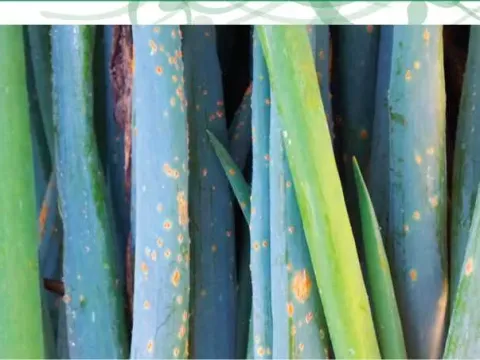
Leek rust
Puccinia allii
The causative agent of this disease is the obligate parasite Puccinia allii, a fungus belonging to the Basidiomycota division. It is a highly specialized pathogen that affects exclusively members of the Alliaceae family, including leeks, onions, garlic, and chives.
What the section contains
Leek rust
The fungus develops mycelium within the leaf tissue, which eventually forms pustules (uredinia). These structures rupture the leaf epidermis, releasing masses of powdery, orange-colored spores that are easily dispersed by wind and splashing water over long distances.
Puccinia allii has a complex life cycle, though in many agricultural regions, it spreads primarily through the asexual urediniospores. The pathogen can survive between growing seasons on infected crop residues or on perennial allium plants growing in the vicinity of fields.
Disease development is highly dependent on environmental conditions, with the fungus thriving in cool to moderate temperatures ranging from +15°C to +22°C. High humidity and prolonged periods of leaf wetness, such as morning dew or fog, are essential for successful spore germination.
The economic impact of the disease is significant, as severe infections cause premature leaf senescence and death. This process significantly reduces the plant's photosynthetic capacity, leading to poor bulb development, lower yields, and reduced storage quality of the harvest.
The pathogen impacts a variety of allium species, causing particular damage to commercial leek and onion crops. In regions with intensive cultivation, the disease can spread rapidly through monocultures, resulting in substantial losses if not managed appropriately.
Initial symptoms consist of small, pale-yellow circular spots on leaves. As the disease progresses, these spots develop into raised pustules, which eventually break through the surface, exposing the characteristic bright, rust-colored or ochre-brown spore masses.
Under heavy infection pressure, the pustules may coalesce, leading to extensive tissue damage and leaf chlorosis. As the season ends, the fungus may produce teliospores, which appear as small, dark, or black streaks on the leaves, signifying the final stage of the infection cycle.
Effective management begins with strict crop rotation, ensuring that allium crops are not grown on the same site for at least 3–4 years. It is also crucial to remove volunteer plants and infected crop debris immediately after harvest to reduce the local inoculum load.
Cultural practices include selecting resistant cultivars where available and ensuring adequate spacing between plants to improve airflow. Proper weed control and avoiding over-irrigation can help maintain a drier microclimate, which is less favorable for spore germination.
Chemical control involves the application of fungicides, particularly those belonging to the triazole or strobilurin classes, at the first sign of symptoms. It is essential to monitor fields regularly and apply treatments according to local regulations to prevent the rapid spread of the rust.