
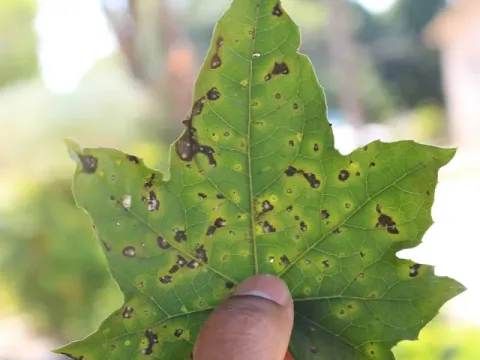
Leandria momordicae
Leandria momordicae
Leandria momordicae is a specialized fungal pathogen classified within the division Ascomycota. It primarily infects plants belonging to the Cucurbitaceae family, including various species of Momordica.
What the section contains
Leandria momordicae
The fungus functions as an obligate or facultative parasite that thrives on the host plant tissue. Its biological existence is intricately linked to the presence of host crops throughout the growing season.
The pathogen reproduces via conidia, which are asexual spores distributed through wind, irrigation water, and farm equipment. These spores germinate on the leaf surface upon contact with moisture.
The mycelium of Leandria momordicae penetrates the epidermis and spreads through the intercellular spaces of the host tissue, causing localized cellular damage and tissue necrosis.
Climatic conditions, particularly high humidity and warm temperatures, are crucial for the development and spread of this fungus. Tropical and subtropical climates provide the most favorable environment for the pathogen.
The host range includes cucumbers, melons, squashes, and bitter gourds (Momordica). The fungus attacks the leaves, stems, and occasionally the fruits, directly compromising plant health.
The primary damage occurs on the leaf blades, where the destruction of chlorophyll cells inhibits photosynthetic activity. This leads to stunted growth and reduced vigor in infected plants.
As the infection progresses, severe necrosis results in premature leaf drop, which exposes fruits to direct sunlight and increases the risk of dehydration and sunburn.
The economic impact involves a significant reduction in market-quality yields. Infected plants often produce undersized fruits, and in severe cases, the entire crop can be lost if not managed properly.
Furthermore, the pathogen can compromise the viability of seeds produced by infected plants, causing long-term issues for subsequent seasons and increasing production costs for farmers.
Initial symptoms are characterized by small, chlorotic spots that appear on the upper surface of the foliage. These spots eventually enlarge and turn into necrotic, brown-colored lesions.
A distinctive feature of Leandria momordicae is the appearance of a sporulating fungal mat on the underside of the leaves. This mat varies from gray to olive-brown depending on moisture levels.
Necrotic tissues may become brittle and tear, leading to a shothole effect on the leaves. In extreme conditions, leaves shrivel, turn yellow, and die off completely, leaving the stems exposed.
Stem infections typically manifest as elongated dark lesions, which may disrupt the transport of nutrients and water, ultimately leading to the wilting of branches or entire plants.
Accurate diagnosis requires observing these characteristic sporulation patterns and microscopic examination of the fungal structures associated with the lesions on the plant tissue.
Integrated Pest Management (IPM) strategies are essential for effective control. Crop rotation, avoiding cucurbits in the same soil for at least three seasons, helps minimize soil-borne inoculum.
Sanitation is critical; removing and destroying crop residues immediately after harvest prevents the pathogen from over-wintering and building up in the field environment.
The use of certified, disease-free seeds and chemical seed treatments can prevent the introduction of the fungus into clean fields, providing a head start for crop protection.
Fungicidal applications are necessary during periods of high disease pressure. Products with systemic activity are generally most effective when applied at the onset of initial symptoms.
Maintaining adequate plant spacing and promoting good air circulation in both field and greenhouse environments help to reduce leaf surface wetness, thereby inhibiting spore germination.