
Pleospora bjoerlingii
Pleospora bjoerlingii
Pleospora bjoerlingii is a specialized fungal phytopathogen belonging to the kingdom Fungi and the phylum Ascomycota. Its conidial stage is widely recognized as Phoma betae.
What the section contains
Pleospora bjoerlingii
The morphological structure of the pathogen is characterized by the formation of pycnidia, which are tiny black fruiting bodies that release colorless conidia. The sexual stage, known as the ascocarp, develops pseudothecia containing ascospores.
This fungus acts as an obligate parasite, surviving in the soil, on plant debris, and within seed lots as dormant mycelium or thick-walled chlamydospores.
Systematically, it is a significant pathogen that causes serious economic losses in beet production worldwide, specifically targeting the health of taproots and foliage.
Laboratory identification of this fungus involves culturing on agar media, where it produces distinct grey or olive-colored colonies, followed by microscopic examination of pycnidial structures.
The primary hosts for Pleospora bjoerlingii are sugar beets, table beets, and fodder beets. It is the causal agent of phoma leaf spot and root rot.
In seedling stages, the pathogen causes "damping-off" or black leg, which can decimate young plant populations shortly after germination.
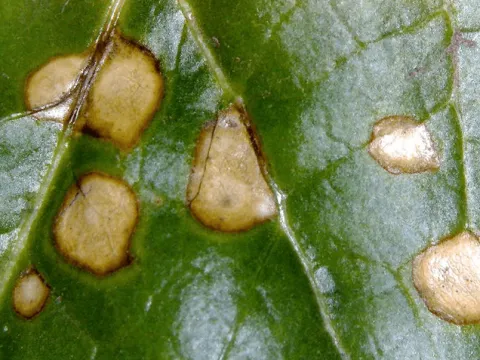
On adult plants, the fungus manifests as leaf spotting, where lesions gradually expand, leading to necrotic tissue and premature senescence of the foliage.
The most severe damage occurs during post-harvest storage, where the fungus induces a dry rot of the roots, significantly reducing sugar content and storage stability.
In seed production fields, the pathogen attacks the floral stems, which decreases overall seed yield and reduces the germination quality of the harvested seed lots.
Infection cycles typically begin in spring as soil temperatures reach 15–20 degrees Celsius, providing the necessary conditions for spore germination.
Throughout the growing season, conidia are disseminated via wind, rainfall splashes, and mechanical insect movement, allowing the fungus to spread rapidly across fields.
Autumn is a critical period for infection, particularly during the harvesting process where mechanical damage to roots facilitates the entry of the fungus into the plant tissues.
The fungus overwinters primarily in infected root remnants left in the field or through latent infection within stored seeds, waiting for favorable conditions to reactivate.
The intensity of the disease development is strongly correlated with rainfall patterns; wet summers create a high risk of epiphytotic outbreaks in beet crops.
On leaves, the symptoms appear as light brown spots arranged in concentric rings. Over time, these spots become speckled with tiny black pycnidia.
Seedling blight is identified by the blackening and constriction of the hypocotyl area, eventually causing the young plant to fall over and die.
Infected taproots develop dark, depressed lesions. When sliced, the internal tissue shows a characteristic dry, brown to black, rotting appearance.
Unlike soft-rotting bacteria, this fungal infection generally remains dry and lacks a foul smell, unless secondary bacterial invaders colonize the lesion.
Seed quality tests can reveal the presence of the pathogen if seeds are placed on moist paper, leading to the development of a dark fungal mycelial mat.
- Implementing long-term crop rotation schemes, keeping beet crops at least 3–4 years apart.
- Using high-quality, fungicide-treated seeds to eliminate both surface-borne and internally-borne infections.
- Deep plowing and removal of harvest residues to break the life cycle of the pathogen in the soil.
- Balanced nutrient management to avoid excessive nitrogen, which can lead to lush, susceptible tissue growth.
- Proper ventilation and climate control in root storage facilities to maintain low humidity and prevent secondary rot outbreaks.