
Plectosporium blight
Plectosporium tabacinum
Description
How to identify
Plectosporium blight is a fungal disease caused by the fungus Plectosporium tabacinum (synonym Plectosphaerella cucumerina). It is classified within the family Plectosphaerellaceae.
This pathogen is a versatile facultative parasite that survives as mycelium or chlamydospores in infested soil and crop debris for several years, making it difficult to eradicate.
Under microscopic observation, it produces characteristic hyaline, septate conidia that allow for rapid dispersal during humid conditions, particularly in greenhouse environments.
The fungus is polyphagous, attacking a wide range of botanical families, though it is most economically destructive to members of the Cucurbitaceae family, including cucumbers, pumpkins, and squashes.
Accurate identification is essential, as the symptoms often mimic other common fungal infections like anthracnose or gummy stem blight, requiring laboratory confirmation through cultural identification.
What it damages
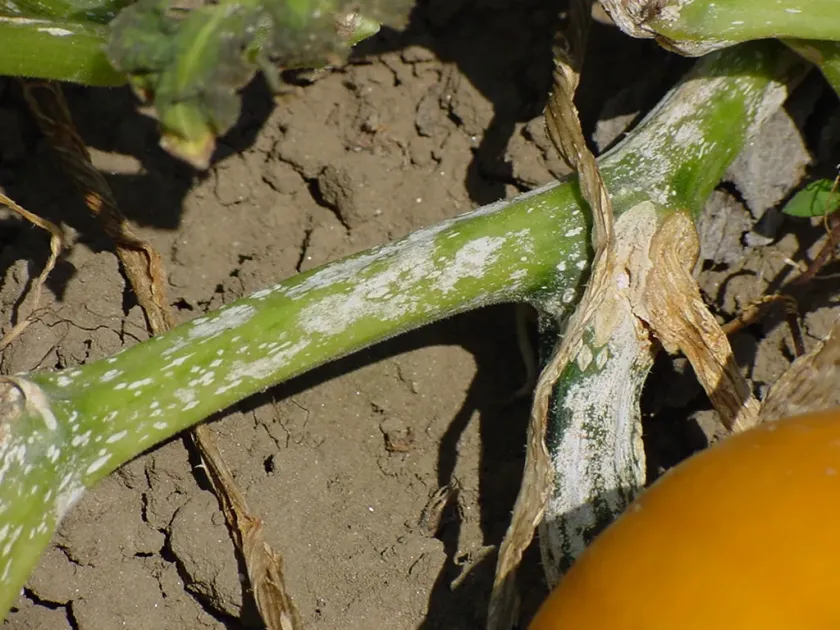
The disease affects all aerial parts of the host plant, including stems, petioles, leaves, and fruit. In the early stages, small, white to light-tan spindle-shaped lesions appear on the plant surface.
As the infection progresses, these lesions enlarge and coalesce, eventually girdling the stems and petioles, leading to the collapse of the plant parts and overall yield reduction.
On fruits, the pathogen causes sunken, dry, necrotic spots. These lesions often serve as entry points for secondary bacterial pathogens, which rapidly degrade the produce, making it unmarketable.
Significant economic loss occurs when the disease reaches epidemic proportions, which is common in areas with high rainfall or in high-density greenhouse production systems.
Beyond direct yield loss, infected plants suffer from reduced photosynthetic capacity, weakening the entire crop and making it more susceptible to other abiotic and biotic stressors.
When it appears
The disease development is highly dependent on environmental conditions, with the fungus favoring warm and humid weather with temperatures ranging from +20°C to +28°C.
Primary inoculum sources include soil-borne chlamydospores, contaminated seeds, and infested crop debris left from previous seasons. Weed hosts can also maintain the pathogen population during the off-season.
Spore dispersal occurs primarily through splashing water, such as rain or overhead irrigation, which distributes the conidia to healthy leaves and stems nearby.
The disease cycle can repeat several times during a single growing season under favorable conditions, leading to an exponential increase in infection levels in susceptible crops.
Drier periods or temperatures outside the optimal range may slow down the fungal growth, but the pathogen persists in the environment, ready to reactivate when conditions become favorable again.
Signs of infestation
Initial signs manifest as tiny, white or light-tan lesions on the stems and leaf petioles. These spots are often overlooked in the very early stages of infection.
As the disease matures, the lesions develop a distinct shape—typically elongated or spindle-like—often surrounded by a thin chlorotic or necrotic margin.
In high humidity, the center of these lesions may develop a whitish, powdery-looking coating, which is actually a mass of conidia produced by the fungus.
Heavily infected plants show severe stunting, leaf chlorosis, and eventual wilting. Stems may become brittle and break easily at the site of the lesions.
In mature fruits, necrotic spotting can be seen clearly. These spots may enlarge, turn brown, and become slightly sunken, significantly impacting the quality of the harvest.
Control measures
Effective management begins with strict crop rotation, ensuring a period of at least 3 years without planting susceptible cucurbits in the same field.
The use of certified, clean seed and treating it with appropriate fungicides is a critical preventive measure to stop the initial introduction of the pathogen into the field.
Sanitation is paramount: all crop debris should be removed and destroyed immediately after harvest to reduce the amount of inoculum that remains in the soil for the next season.
Fungicide applications, particularly those containing systemic active ingredients, can be effective if applied early in the disease cycle, following recommended label rates and rotation schedules.
Cultural practices like improving field drainage, pruning to increase air circulation, and avoiding overhead irrigation can significantly reduce the infection pressure by lowering the humidity around the plants.
Causes diseases · 1
Discussion
No discussions yet — be the first.