
Plenodomus lindquistii
Plenodomus lindquistii
Plenodomus lindquistii, formerly known as Phoma macdonaldii, is a significant fungal pathogen within the Dothideomycetes class. It is recognized as the primary causal agent of Phoma stem canker, one of the most destructive diseases affecting sunflowers globally.
What the section contains
Plenodomus lindquistii
Systematically, this pathogen belongs to the genus Plenodomus. The fungus is characterized by the production of pycnidia, which are asexual fruiting bodies that contain conidia, the primary spores responsible for the rapid spread of the disease within the crop canopy.
The fungus survives as mycelium and pycnidia in infested crop debris, such as sunflower stalks left on the soil surface. This resilience allows the pathogen to persist in agricultural fields for several years, even in the absence of a host crop.
Infection cycles are largely driven by environmental factors. Conidia are disseminated through rain splashes and wind, moving from infected crop residues to healthy tissues of developing sunflower plants, which marks the start of a new epidemic cycle.
Seed transmission is also a documented pathway for the dissemination of this pathogen. Ensuring high-quality, disease-free seed is therefore critical for preventing the early establishment of the fungus in newly planted sunflower fields.
The primary host for Plenodomus lindquistii is the cultivated sunflower Helianthus annuus. The disease severely impairs plant health, leading to significant yield losses due to reduced seed weight, lower oil content, and occasional total plant lodging.
The pathogen infects all aerial parts of the plant. Initial infections typically occur on lower leaves, causing necrosis, which then spreads to the petioles and eventually reaches the main stem, forming characteristic lesions that obstruct vascular transport.
Stem infection is the most damaging phase. As the pathogen destroys the internal tissue of the stem, the structural integrity of the plant is compromised, making it highly susceptible to lodging, especially during the grain-filling stage when the sunflower head is heavy.
Root system damage also occurs, though it is often secondary to the stem infection. By weakening the roots, the fungus reduces the plant's ability to uptake water and nutrients, making the crop significantly more vulnerable to environmental stresses like drought.
In cases of severe infection, the head of the sunflower may also show signs of necrosis, leading to poor seed set and malformation. This not only reduces yield but also diminishes the quality and market value of the harvested oilseeds.
The development of the disease is highly dependent on climate. Favorable conditions for Plenodomus lindquistii include temperatures between 15°C and 25°C, combined with high relative humidity and frequent rainfall, which facilitate spore germination.
The disease cycle can repeat multiple times throughout the growing season. The initial infection is often observed at the 2 to 4-leaf stage, making early season monitoring essential for identifying the presence of the pathogen before it spreads.
During the summer months, particularly during the budding and flowering stages, the pathogen reaches its peak activity. Frequent summer rains during these phenological stages provide optimal conditions for the massive dispersal of conidia across the field.
As the season progresses toward autumn, the fungal activity shifts toward colonization of senescing tissues. During this phase, the fungus produces pycnidia on the stems, ensuring that a robust inoculum reservoir is available for the subsequent growing season.
Late-season rainfall can accelerate the deep colonization of the stalk, which ensures the survival of the fungus in the field residue. This overwintering mechanism is the cornerstone of the disease's persistence in crop rotation cycles.
The first visual symptom of Phoma stem canker is the appearance of dark brown or black lesions on the margins of lower leaves. These spots gradually expand, covering the entire leaf blade and causing the tissue to wither and die prematurely.
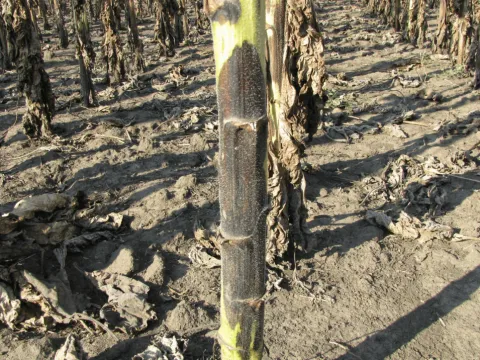
Stem symptoms are diagnostic, appearing as distinct dark, irregular-shaped necrotic zones centered at the point where the leaf petiole attaches to the stem. These lesions often expand rapidly, circling a significant portion of the stem circumference.
Upon closer inspection of the lesion surfaces, one can identify tiny black dots, which are the pycnidia. These fruiting bodies are often grouped together and are a clear indicator of the presence of the fungal pathogen.
If an infected stem is sliced open, the internal pith (parenchyma) shows severe darkening and necrosis. In advanced stages, the internal tissue disintegrates, leaving a hollow, blackened stem that is prone to breaking under moderate wind pressure.
Overall, infected plants appear stunted and display signs of premature senescence compared to healthy neighbors. This uneven ripening in the field is a major symptom that often becomes apparent just before the crop reaches maturity.
The most effective strategy for managing Plenodomus lindquistii is the utilization of genetically resistant sunflower hybrids. Breeding programs focusing on resistance are vital for sustaining sunflower production in areas with high disease pressure.
Cultural practices are indispensable, particularly the use of long-term crop rotation. A gap of 6 to 8 years between sunflower plantings is highly recommended to allow the natural degradation of infested crop residues in the soil.
Deep plowing or mechanical incorporation of sunflower stalks into the soil can speed up the decomposition process of the infected material, thereby reducing the available inoculum load for the next season.
Chemical control involving systemic fungicides, specifically those in the strobilurin and triazole classes, can be effective. Optimal timing for application is during the 4 to 8-leaf stage, which protects the plant during its most vulnerable phase of growth.
Seed treatment with high-efficacy fungicides is a standard preventive measure. This protects the germinating seedlings from soil-borne inoculum and prevents the early establishment of the disease, which is crucial for maximizing final yields.