
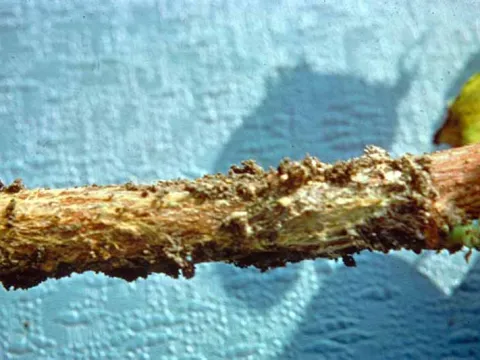
Phymatotrichum root rot
Phymatotrichopsis omnivorum
The causative agent of this disease is the soil-borne fungus Phymatotrichopsis omnivorum, which belongs to the kingdom Fungi. It is considered one of the most destructive soil-borne plant pathogens globally, capable of persisting in the soil for decades through survival structures.
What the section contains
Phymatotrichum root rot
The fungus produces extensive mycelial strands that wrap around the root systems of host plants. These strands penetrate the vascular tissues, blocking water and nutrient transport, which inevitably leads to the rapid wilting and eventual death of the host.
Survival is ensured by the formation of sclerotia, which are dark, dense structures that remain dormant in the soil. These sclerotia can be found at depths of up to three meters, making eradication extremely difficult.
This pathogen thrives in alkaline soils with high clay content. Such environments, coupled with warm temperatures, provide the ideal conditions for the fungus to spread rapidly across agricultural land.
The damage caused is systemic, resulting in severe disruption of the plant's physiological functions, specifically the inability to maintain turgor pressure even when environmental conditions seem favorable.
Phymatotrichum root rot affects more than 2,000 species of dicotyledonous plants, including vital crops such as cotton, alfalfa, fruit trees, and various ornamental plants. It poses a massive economic threat to agricultural stability.
In highly infested areas, yield losses can reach up to 100 percent. The presence of the pathogen often renders land unsuitable for susceptible crops, forcing farmers to abandon fields or switch to resistant, often less profitable, varieties.
In orchards and vineyards, the fungus causes progressive degradation of root systems, leading to canopy decline, yellowing of foliage, and premature death of permanent crops, which represents a long-term investment loss.
The economic impact extends beyond crop loss, as the presence of the pathogen triggers international or local quarantine regulations, restricting the movement of nursery stock and planting materials.
Because the fungus spreads primarily through root-to-root contact, the infestation creates expanding patches of dying plants, effectively destroying production capacity across large sections of a farm.
The development of Phymatotrichum root rot is closely tied to warm weather. The fungus is most active when soil temperatures range between 25 and 35 degrees Celsius, which is typical for the peak growing season.
Infection symptoms usually become visible in mid-to-late summer. Fluctuations in soil moisture, particularly heavy rains following a dry spell, often stimulate the rapid colonization of roots by the pathogen.
During colder months, the fungus enters a dormant state as sclerotia. These structures remain protected in the deep soil profile, waiting for the return of favorable temperatures to resume growth and infection cycles.
The spread of the disease is generally horizontal, moving from an initial infection point to neighboring plants. Monitoring is crucial during the hottest months to detect early signs of localized outbreaks.
The rate of expansion depends on soil temperature and humidity levels, meaning that the disease progression can vary significantly from year to year depending on local weather patterns.
The first external sign of infection is the sudden yellowing and wilting of leaves during the hottest hours of the day. While plants may recover turgor at night initially, the wilting becomes permanent over time.
Upon examination of the root system, one can identify distinct brown mycelial strands clinging to the bark. Eventually, the root bark rots and becomes necrotic, easily sloughing off from the woody tissue.
In cases of high humidity, a fungal mat may develop on the soil surface near the crown of the infected plant. The plant will typically be easily pulled from the soil due to the extensive destruction of the lateral root system.
Outbreaks appear as circular patches of dead or dying plants in the field. As the season progresses, these patches expand, leaving behind areas of total crop loss.
- Sudden wilting during peak temperature hours.
- Necrotic and decaying root cortex.
- Brown, rope-like fungal strands on roots.
- Formation of circular dead zones in the field.
Due to the deep-seated nature of Phymatotrichopsis omnivorum, effective management requires an integrated approach. Eradication is rarely possible; instead, the focus is on containment and suppression.
Crop rotation remains a primary strategy. By alternating susceptible crops with resistant ones—specifically monocots like cereal grains—the inoculum density in the soil can be significantly reduced over several seasons.
Deep plowing can help disrupt the soil environment and expose sclerotia to adverse conditions, such as ultraviolet light and rapid temperature fluctuations, potentially reducing their survival rates.
Organic amendments and high-quality composts are often recommended to increase soil biodiversity. A diverse microbial community can compete with the pathogen, suppressing its growth in the root zone.
While chemical soil fumigants or specific fungicides may be used in high-value production systems, their efficacy is often hampered by the depth at which the pathogen exists, making site-specific management a necessity.