
Phymatotrichum root rot
Phymatotrichiopsis omnivora
The causative agent of the disease is the soil-borne fungus Phymatotrichiopsis omnivora, a member of the division Ascomycota. It is a highly persistent pathogen that survives in the soil for many years in the form of sclerotia, making it extremely difficult to eradicate from infested fields.
What the section contains
Phymatotrichum root rot
The fungus thrives in alkaline, clay-rich soils, which dictates its primary geographic distribution in warmer climate zones. It develops characteristic mycelial strands that aggregate to form dense, root-like structures, allowing the pathogen to spread effectively through the soil.
Systematically, this species occupies a unique niche among soil pathogens due to its specific survival mechanism. Unlike many other fungi, it does not produce typical wind-borne spores, meaning its spread relies heavily on mycelial growth and the movement of infested soil particles.
Microscopic observation reveals branching hyphae with characteristic cruciform structures. These features allow the fungus to securely attach to the host's root system, facilitating the extraction of nutrients and water from the plant tissues, leading to rapid disease development.
The biology of this pathogen is highly dependent on soil temperature and moisture levels. Given its inability to produce spores, its long-term survival is maintained entirely by sclerotia buried deep within the soil profile, often well below the reach of standard cultivation tools.
Phymatotrichiopsis omnivora is a highly polyphagous pathogen, capable of infecting over two thousand species of dicotyledonous plants. This wide host range makes it a significant threat to various agricultural sectors, including cotton production, orchards, and viticulture.
The most severe economic impact is typically observed in cotton fields, where the disease causes rapid wilting and plant death during the peak of the growing season. Beyond cotton, it poses a severe threat to alfalfa, grapes, and a wide array of fruit and ornamental trees.
The primary damage occurs within the root system, where the fungus destroys the bark and vascular tissues. This prevents the plant from absorbing water and minerals, leading to sudden wilting symptoms that often appear during hot, dry periods when transpirational demand is highest.
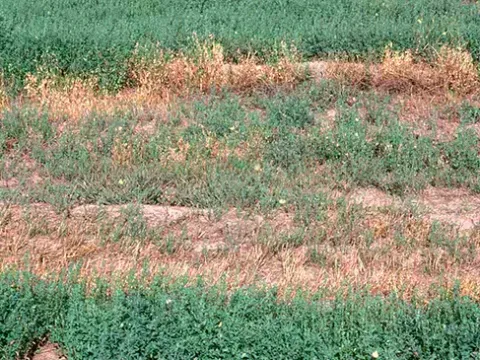
The infection spreads in circular patterns or patches that expand radially each year. Within these infected areas, it is nearly impossible to grow susceptible crops, as the pathogen eliminates the root systems of virtually all host plants, resulting in total crop loss in those sections.
The damage is compounded by the pathogen's ability to survive in deep soil layers, rendering traditional chemical fungicides largely ineffective. This persistent nature forces farmers to abandon or limit the use of infested lands for highly susceptible commercial crops.
The first external sign of infection is the sudden yellowing and wilting of foliage during the hottest parts of the day. While plants may recover some turgor during the night, the overall condition of the plant progressively declines over several days until it dies permanently.
Upon inspecting the roots, one can observe brown necrotic lesions covered with a distinctive yellow-to-tan mycelial growth. This fungal mat adheres tightly to the surface of the roots and eventually colonizes the root bark, causing it to slough off easily.
In humid conditions, a fine, thin crust of mycelium can sometimes be observed on the soil surface at the base of the stem. This serves as a critical diagnostic indicator that the fungus is actively developing within the immediate root zone of the plant.
As the disease reaches its final stage, the plant dries out completely, yet the withered leaves often remain attached to the stem for an extended period. A tell-tale sign is that the plant can be pulled out of the soil with minimal effort, as the secondary roots have been completely destroyed.
- Sudden wilting of leaves during midday.
- Necrotic brown lesions on the roots.
- Visible mycelial strands on root surfaces.
- Drying of the entire plant while leaves remain attached.
- Formation of expanding circular infection patches.
Managing Phymatotrichiopsis omnivora requires an integrated approach focusing on cultural practices, as chemical control remains largely limited by the pathogen's depth in the soil profile. The primary goal is to prevent the introduction and spread of the fungus into new areas.
Crop rotation using monocotyledonous plants, such as cereals and grasses, is a recommended strategy. Since these plants are not susceptible to the fungus, they help reduce the density of the pathogen's population in the soil over several growing seasons.
Deep plowing can help disrupt the mycelial strands, but it must be performed with caution to avoid spreading infested soil to non-infected parts of the field. Cleaning machinery after use in infested areas is essential to prevent the mechanical transfer of sclerotia.
Enhancing soil health through the addition of organic matter and green manures can foster beneficial microbial communities that may suppress the growth of the pathogen. Biological control agents that compete for nutrients in the rhizosphere are an active area of research.
Strict quarantine and sanitation measures are the most effective way to prevent the disease from entering new production zones. By managing the movement of soil and ensuring that planting materials are free from the pathogen, farmers can minimize the risk of devastating outbreaks.