
Phoma blight of soybean
Phoma glycinicola
The causative agent of Phoma blight of soybean is the fungus Phoma glycinicola (also identified as Phoma sojae), which belongs to the Dothideomycetes class.
What the section contains
Phoma blight of soybean
This pathogen survives primarily as mycelium and pycnidia on infected crop residues left in the field, as well as on infested soybean seeds, ensuring its survival between growing seasons.
Primary infection occurs through the spread of pycnidiospores via wind and rain splashes, which land on susceptible plant tissues during the soybean growing period.
The fungus thrives in cool to moderately warm, humid environments, where it can complete its life cycle rapidly if moisture levels remain high for extended periods.
It is a persistent pathogen that can survive in the soil for several years, necessitating careful field management to mitigate the long-term risk of infestation.
Phoma blight causes significant reductions in soybean productivity by damaging stems, petioles, and pods, which disrupts nutrient transport and reduces photosynthesis.
Severe infections lead to weakened stems, causing plants to lodge (fall over) and making them difficult to harvest, which results in substantial mechanical yield losses.
The development of lesions on pods frequently leads to poor seed development, lower oil and protein content, and increased seed rot, which lowers the market grade.
Infected seeds serve as a reservoir for the fungus, perpetuating the disease cycle in subsequent seasons and spreading the pathogen to previously clean fields.
General plant vigor is compromised as the disease progresses, leaving infected fields more susceptible to secondary stressors and further biological damage.
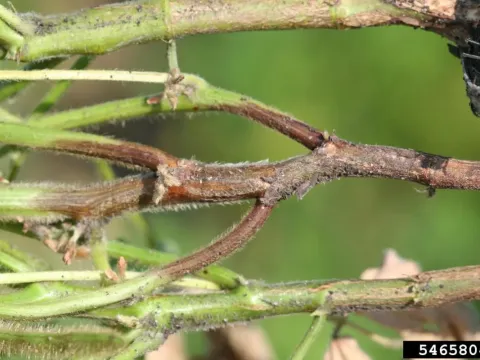
Early symptoms typically appear as small, dark brown, or greyish lesions at the nodes or leaf attachment points on the stems, later expanding to become irregular in shape.
Small, black, pimple-like structures, known as pycnidia, eventually emerge within the necrotic lesions, serving as the identifying characteristic of the fungus.
As the infection progresses, leaves may turn yellow and wither prematurely, significantly reducing the plant's ability to fill its pods effectively.
Pods show dark, often sunken spots that can penetrate to the seeds inside, potentially causing discoloration or reducing seed size depending on the timing of the infection.
- Dark brown lesions on stems and nodes.
- Presence of minute black pycnidia on affected tissue.
- Premature chlorosis and leaf drop.
- Sunken necrotic patches on pods.
Seed treatment with systemic fungicides is the first line of defense to prevent early-season infections arising from contaminated seed lots.
Implementing a crop rotation cycle that avoids planting soybeans in the same field for at least 3 years helps deplete the population of the pathogen in the soil.
Effective management of crop debris, including deep plowing and incorporation of residues into the soil, accelerates the decomposition of the pathogen's substrate.
Foliar fungicide applications during the R1 (beginning bloom) to R3 (beginning pod) stages can be highly effective in controlling the spread of the disease if environmental conditions favor development.
Selecting disease-resistant or tolerant soybean varieties remains one of the most sustainable methods to maintain yields while reducing dependence on chemical control measures.