
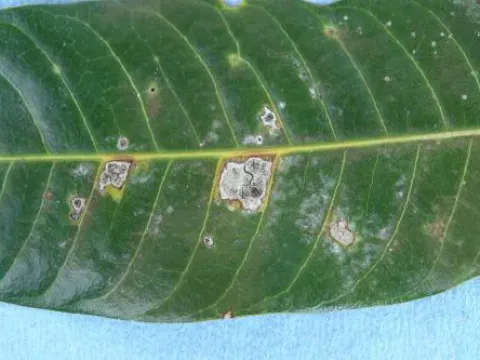
Pestalotia mangiferae
Pestalotia mangiferae
Pestalotia mangiferae is a fungal plant pathogen belonging to the phylum Ascomycota. It is widely recognized as a serious threat to mango trees and various other tropical plants, particularly in regions with high precipitation and humidity.
What the section contains
Pestalotia mangiferae
The pathogen is identified by its distinctive conidiomata, known as acervuli, which appear as small black spots on the infected tissues. These structures produce conidia that are multicellular and spindle-shaped, possessing characteristic appendages at both ends.
This fungus acts as both a necrotrophic parasite and a saprophyte. It colonizes plant tissue by secreting enzymes that degrade cell walls, eventually causing the death of the plant cells and allowing the fungus to feed on the organic matter.
The life cycle is primarily driven by moisture. During rainfall or heavy dew, the conidia are released from the acervuli and dispersed via water splashes or wind, leading to the rapid infection of healthy plant tissues nearby.
As a resilient pathogen, Pestalotia mangiferae survives in decaying leaves and twigs, maintaining its presence in the orchard environment year-round and acting as a primary source of inoculum for the next growing season.
The primary host for this pathogen is the mango tree (Mangifera indica). However, it has been observed on several other species, indicating a broader host range under favorable climatic conditions.
Damage to foliage is common, manifesting as leaf spots that reduce the tree's photosynthetic efficiency. Severe infections often lead to premature leaf drop, which weakens the overall health and vigor of the tree.
The impact on fruit production is the most economically significant. Infected fruits develop dark, sunken lesions that deteriorate quickly, rendering them unsuitable for market distribution or human consumption.
Twig and stem infections are equally destructive. The fungus can cause cankers and dieback, effectively girdling branches and stopping the flow of nutrients, which can ultimately lead to the death of the entire branch.
Weakened trees, or those stressed by poor nutrition and irrigation, are significantly more susceptible to Pestalotia mangiferae, resulting in higher mortality rates and reduced crop yields for growers.
Early symptoms typically include small, brownish-grey spots on leaves. As the infection progresses, these spots expand, often forming irregular patterns that may cover a significant portion of the leaf surface.
A telltale sign of the presence of Pestalotia mangiferae is the formation of small, black, dot-like fruiting bodies (acervuli) in the center of the necrotic lesions. These dots are often arranged in concentric circles.
On fruits, the infection begins as small, discolored depressions that gradually deepen. In humid environments, these spots can produce a visible mass of spores, often described as a greyish or creamy exudate.
Dieback is a critical sign, especially in young shoots, where the tip of the twig turns black and shrivels. This dieback can progress downwards, indicating the systemic movement of the fungus within the vascular system.
Chlorosis, or yellowing of the tissue surrounding the necrotic spots, is frequently observed, reflecting the plant's physiological stress response to the toxins produced by the fungus.
Effective management requires an integrated approach focusing on sanitation and the strategic application of fungicides to prevent the spread of the pathogen.
- Rigorous pruning of infected branches and stems to reduce the source of inoculum.
- Prompt removal and destruction of fallen leaves and infected fruit from the orchard floor.
- Improving orchard airflow through proper spacing and canopy management to reduce humidity levels.
- Application of copper-based or systemic fungicides during vulnerable growth stages.
- Ensuring proper plant nutrition to strengthen host resistance against fungal infections.
Timely intervention is essential; since the fungus spreads rapidly through water, prophylactic sprays applied before the rainy season are highly recommended to minimize the risk of a widespread outbreak.