
Late blight
Potato leaf
Description
How to identify
The pathogen responsible for late blight is the oomycete Phytophthora infestans, which belongs to the kingdom Chromista. It is a highly aggressive microorganism capable of causing significant crop failure.
The mycelium grows intercellularly within the plant tissues, extracting nutrients directly from the host. Under high humidity, it produces sporangiophores through the stomata to facilitate rapid spread.
The life cycle involves asexual reproduction through motile zoospores, which require liquid water for movement and infection. These spores are highly mobile and can travel significant distances in wind-blown rain.
Phytophthora infestans possesses a high level of genetic plasticity, allowing it to adapt to various environmental conditions and overcome the resistance of many crop varieties.
In the absence of a host, the pathogen survives in infected tubers, soil debris, or as oospores. This longevity in the environment makes total eradication extremely difficult.
What it damages
Late blight primarily attacks potato and tomato plants. It can also infect other Solanaceous plants, such as eggplant, petunias, and some wild nightshade species.
The destruction of leaf tissue leads to a total collapse of photosynthesis. Without a healthy canopy, the plant cannot develop healthy tubers or fruits, leading to immediate yield loss.
Stem infection is particularly lethal, as it restricts the movement of water and nutrients throughout the plant. This often causes the plant to wilt and break, leading to early senescence.
Potato tubers and tomato fruits suffer from direct infection, which appears as hard, dark, necrotic lesions. These affected parts become susceptible to secondary soft rot pathogens.
The economic impact of late blight is global, resulting in billions of dollars in losses annually. It remains one of the most monitored and feared diseases in commercial potato production.
When it appears
The disease thrives in cool to moderate temperatures, typically between 15°C and 22°C, combined with high relative humidity. Frequent rainfall and fog are classic triggers for outbreaks.
Late spring and early summer, when foliage is lush and dense, are high-risk periods. When rows close, the microclimate within the canopy traps moisture, favoring spore germination.
Hot, dry weather can temporarily inhibit the pathogen. However, it does not kill the fungus, which remains dormant in the lower, shaded parts of the canopy until conditions improve.
Autumn conditions, characterized by cooling temperatures and heavy dew, significantly increase the risk to potato tubers during the pre-harvest period.
Monitoring weather patterns is critical for timing fungicide applications. Modern agronomists use predictive models to forecast outbreaks before symptoms appear on the crop.
Signs of infestation
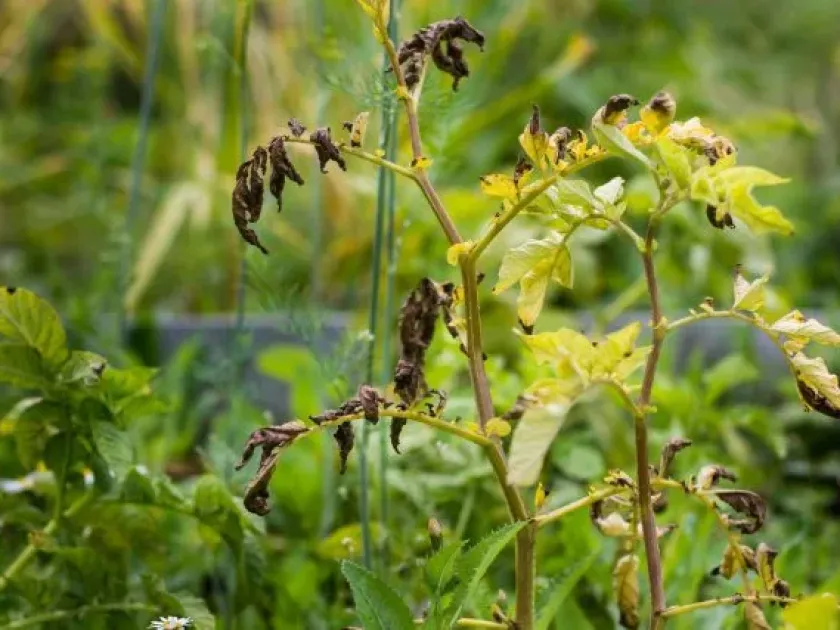
Initial symptoms are characterized by water-soaked, dark spots on the foliage. These lesions often grow rapidly, turning brown or black as the tissue dies.
A white, fuzzy growth appears on the underside of infected leaves, particularly near the edges of the lesions. This is the sporulation of the pathogen, which spreads via wind and rain splashes.
Stems often develop elongated dark brown streaks or lesions. These areas become brittle, leading to the collapse of the plant structure under stress or heavy winds.
Infected potato tubers display sunken, discolored patches on the skin. Cutting into the tuber reveals a reddish-brown, dry rot that can penetrate deep into the flesh.
Tomato fruits develop firm, dark brown patches. Unlike common fruit rots, late blight lesions remain firm unless secondary bacteria enter the tissue and cause soft decay.
Control measures
Choosing resistant cultivars is the first line of defense. Breeders continuously develop varieties that can slow down the progression of the disease.
Integrated Pest Management (IPM) practices, such as ensuring proper plant spacing and removing crop residues, are vital to reducing the infection pressure in the field.
Chemical control involves the preventative application of fungicides. Systemic fungicides are often used in rotation with protectant products to prevent the buildup of resistance.
Tuber protection involves killing the foliage (desiccation) a week before harvest. This prevents the spores on the leaves from coming into contact with the tubers during the digging process.
Post-harvest storage should be managed at low temperatures with proper ventilation. Keeping the tubers clean, dry, and cool is essential to preventing the spread of late blight in storage.
Causes diseases · 2
Discussion
No discussions yet — be the first.