
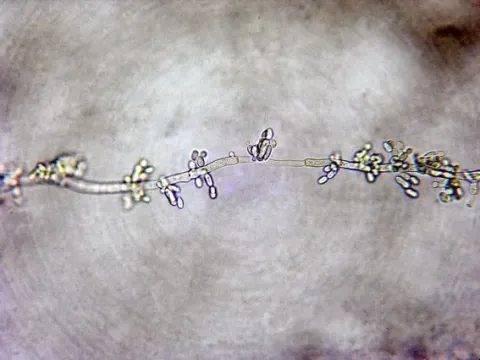
Hormonema
Hormonema
Hormonema is a genus of mitosporic fungi (anamorphic stage) belonging to the group of black, yeast-like, or dematiaceous fungi. They are classified within the order Capnodiales, family Dothioraceae.
What the section contains
Hormonema
These fungi often exist as endophytes, living within plant tissues for extended periods without manifesting obvious symptoms. They do not form complex fruiting bodies, instead producing simple, yeast-like colonies with abundant conidiation.
The mycelium and conidia are heavily melanized, which provides protection against environmental stress, including high UV radiation and desiccation. Colonies typically appear olive, gray, or black.
Identification often requires specialized laboratory techniques, including isolation on nutrient media and microscopic examination of conidiogenesis, as they can easily be mistaken for harmless saprophytes.
The biological versatility of this fungus allows it to colonize diverse substrates, making it a widespread organism in various climates, especially where humidity levels remain elevated for long periods.
This pathogen affects a wide range of plants, including conifers (like pine and juniper) and various deciduous trees. It acts as both an opportunist and a parasite, depending on the plant's physiological state.
The fungus typically enters through stomata or mechanical wounds. Once inside, it begins colonizing the mesophyll or epidermal tissues, disrupting normal cellular function and nutrient transport.
Damage manifests as tissue necrosis, leading to reduced photosynthetic capacity. This eventually stunts growth and weakens the plant, making it more susceptible to secondary stressors such as insect attacks or extreme weather.
In forest nurseries or plantations, heavy infestation leads to premature needle cast, significantly impacting the growth rate and overall marketability of ornamental or timber crops.
Economic losses are cumulative, arising from the need for fungicide applications, the loss of plant biomass, and the degradation of the aesthetic value of landscape plantings.
Initial infection symptoms appear as chlorotic spots that quickly turn into dark, necrotic lesions. These spots may be irregularly shaped and vary in size depending on the host species and environmental conditions.
A characteristic sign is the development of a dark, sooty, or grayish coating on the surface of the infected needles or leaves, representing the fungus's massive sporulation.
As the infection progresses, affected tissues turn brown and die. In conifers, needle curling and premature shedding are common, often starting from the lower canopy where moisture levels are higher.
Unlike some other leaf spot diseases, Hormonema lesions often lack sharp, brightly colored margins, instead presenting as diffuse, dark areas of tissue death.
Confirmation of the presence of Hormonema usually involves observing the characteristic conidia under a microscope, distinguishing it from other fungi that cause similar necrotic patterns.
Integrated pest management (IPM) is essential for control. Proper cultural practices, such as increasing plant spacing and pruning, improve airflow and help reduce local humidity, making the environment less hospitable for fungal growth.
Sanitation is a vital measure: removing and destroying infected needles and leaf litter prevents the pathogen from overwintering and reinfecting the crop the following season.
Chemical control involving copper-based fungicides or systemic triazole compounds can be highly effective in stopping the spread and protecting new growth during susceptible periods.
Promoting overall plant vigor through balanced fertilization and appropriate irrigation helps plants better defend against infection and recover from initial damage caused by the pathogen.
Regular scouting during periods of high humidity allows for early detection, enabling timely preventive treatments and minimizing the need for heavy pesticide usage across the field or nursery.