
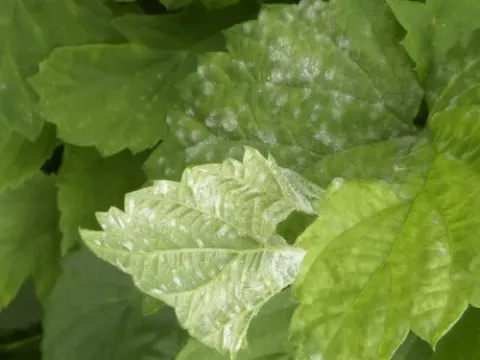
Hop powdery mildew
Podosphaera macularis
The causal agent is Podosphaera macularis, a specialized fungal pathogen belonging to the phylum Ascomycota. This pathogen is highly host-specific, primarily affecting the hop plant (Humulus lupulus) by colonizing its aerial surfaces.
What the section contains
Hop powdery mildew
The life cycle involves an asexual phase (conidia), which facilitates rapid disease spread, and a sexual phase (cleistothecia), which ensures the fungus can survive the winter period in debris or buds.
Dispersal is mainly wind-driven; millions of microscopic conidia are carried across hop yards, landing on susceptible tissues. Once a spore adheres to the leaf surface, it germinates and develops haustoria to extract nutrients.
The pathogen thrives in moderate temperatures and high humidity, yet it is highly resilient, capable of persisting in the environment even when conditions are suboptimal for short durations.
Due to the pathogen's ability to produce new strains through sexual recombination, hop growers must remain vigilant, as new races can evolve that overcome traditional resistance in commercial varieties.
Powdery mildew severely impacts the vegetative and reproductive stages of the hop plant. Infected leaves experience reduced photosynthetic capacity, leading to overall plant stunting and reduced vigour.
The most economic damage occurs on the hop cones. Infection causes the cones to brown, deform, and stop developing properly, which renders them commercially useless for the brewing industry.
Significant infestations can lead to early defoliation, which weakens the plant crown. This negatively affects the plant's ability to store energy for the following spring, leading to yield declines over multiple years.
Marketable quality is destroyed by the presence of the white fungal mat, which is unsightly and introduces off-flavors, making the crop unacceptable for high-quality beer production.
In severe epidemics, the entire harvest of a hop yard can be rendered worthless, causing immense financial losses for growers and disrupting supply chains for the malting and brewing sectors.
The disease cycle typically begins in the late spring when overwintering spores are triggered by rising temperatures and rainfall. Initial infections usually occur on the basal leaves near the soil surface.
As the season progresses through summer, the pathogen moves upward along the bines, reaching the developing cones. Mid-summer conditions are often optimal for rapid exponential growth of the fungal population.
Night-time dews and morning mists provide the necessary moisture for spores to penetrate the plant cuticle. Even in drier climates, the humidity trapped within dense hop foliage is sufficient for the fungus to spread.
By late summer and early autumn, the fungus shifts toward its sexual stage. The appearance of dark, pin-head-sized cleistothecia on bines and leaves marks the preparation for dormancy.
During peak heat (above 30°C), the pathogen's growth may slow down significantly, but it does not disappear, remaining ready to resume activity as soon as the ambient temperature moderates.
The primary symptom is the emergence of white, powdery, mycelial patches on the leaf surfaces. These patches start as small spots but can coalesce to cover the entire leaf, giving it a dusted appearance.
Leaves may turn yellow (chlorotic) around the edges and eventually become necrotic. The plant tissue often twists or curls in response to the infection, leading to visible deformation of the bine.
Infected cones show greyish or white discolouration, which eventually turns into dark brown necrotized tissue. The cones often feel brittle to the touch compared to healthy, flexible ones.
In cases of heavy infection, a foul, musty odour emanates from the infected foliage and cones, which is a clear indicator of a severe fungal infestation within the hop yard.
Using a magnifying lens, one can observe the characteristic branched chains of conidia, which appear like tiny, glistening pearls attached to the greyish web of mycelium covering the plant.
- Selecting resistant hop cultivars is the most effective long-term strategy for managing powdery mildew in commercial production.
- Proper trellis management and spacing ensure adequate airflow, which keeps the foliage dry and inhibits fungal growth.
- Sanitation practices, such as removing fallen leaves and pruning basal growth, significantly reduce the initial inoculum level.
- Implementing a structured spray program using appropriate fungicides (e.g., sulfur-based or systemic inhibitors) during critical growth stages.
- Rotating different chemical classes of fungicides is essential to prevent the pathogen from developing resistance to common control agents.