
Guignardia citricarpa
Guignardia citricarpa
Guignardia citricarpa is a fungal pathogen belonging to the Ascomycota phylum and the order Botryosphaeriales. It is the causative agent of Citrus Black Spot (CBS), a significant disease affecting various citrus species globally.
What the section contains
Guignardia citricarpa
The fungus is characterized by two distinct stages: the sexual stage (Guignardia citricarpa, teleomorph), producing ascospores, and the asexual stage (Phyllosticta citricarpa, anamorph), producing pycnidiospores. Both stages play a critical role in the life cycle of the pathogen.
Given its impact on international trade, Guignardia citricarpa is classified as a major quarantine organism in many countries. Regulatory measures are strictly enforced to prevent its introduction into non-infected production areas.
Identification of the pathogen requires specialized mycological techniques. PCR-based molecular diagnostics are the gold standard for confirming the presence of this specific pathogen, as morphological symptoms can sometimes be confused with other citrus diseases.
The host range of this fungus covers most economically important citrus varieties, including oranges, lemons, mandarins, and grapefruits. It is particularly devastating in subtropical regions characterized by heavy rainfall and high humidity.
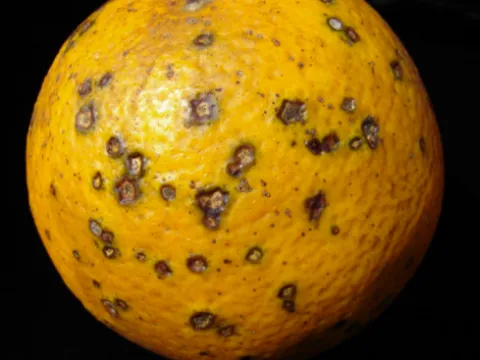
The most severe damage is caused to the fruit rind, where the fungus induces dark, sunken lesions. These spots not only spoil the aesthetic appearance of the fruit but also render it unacceptable for the fresh export market.
In addition to fruit lesions, the pathogen causes premature abscission of leaves and fruitlets, leading to canopy thinning and reduced tree vigor. Severe infections can result in the dieback of shoots and branches, significantly lowering long-term yield.
Economic losses are compounded by the high costs of intensive fungicide spray programs required to keep the disease in check. Furthermore, detections of CBS in export shipments frequently lead to bans from importing countries, causing substantial losses to farmers.
The disease often remains latent in fruit during the growing season. This creates a risk where asymptomatic fruit, when harvested and stored in refrigerated conditions, may develop black spots during transit, resulting in the rejection of entire consignments.
Nursery plants can serve as reservoirs for the pathogen if infected. The movement of such plants is a primary pathway for the spread of Guignardia citricarpa across different geographical regions.
The disease cycle is strongly influenced by weather conditions. Periods of high moisture, particularly intermittent rain and warm temperatures (ranging from 20°C to 30°C), promote the release and spread of spores.
Ascospores are primarily produced on fallen, decomposing leaves within the orchard. Once released, they are dispersed by wind and rain splash, targeting susceptible young fruit and leaves in the canopy.
The latent period, which is the time between infection and the appearance of symptoms, can be quite long. This makes early detection difficult, as the fungus can remain dormant in host tissues for several months before lesion development.
The critical window for infection is during the spring and summer months when citrus trees are actively growing and producing new fruit. Protecting young fruit during this phase is vital to preventing the establishment of the disease.
After the harvest, the fungus persists in the leaf litter. The production of sexual fruiting bodies continues as long as there is moisture, ensuring a continuous supply of inoculum for the next growing season.
The classic symptom is the appearance of black, necrotic spots on the fruit surface. These spots are often circular, firm, and sunken in the center, sometimes surrounded by a lighter halo of chlorotic tissue.
Leaf lesions typically appear as dark brown to black spots with a greyish center. In favorable conditions, tiny black dots known as pycnidia (the asexual fruiting bodies) emerge within these necrotic areas.
Branch infections present as irregular lesions and fissures, which can progress into dieback. These symptomatic branches act as a source of spores that can be washed down onto fruit throughout the canopy.
In cases of severe infection, lesions may coalesce, covering large parts of the fruit rind. This creates a rough, scarred appearance that drastically reduces the market value of the produce.
In the field, visual diagnosis involves looking for these characteristic patterns on both fruit and older leaves. However, confirming the species often requires observing the fungal structures under a microscope or performing molecular tests.
Effective management relies on an integrated approach, starting with strict quarantine protocols to restrict the movement of citrus material from infected areas. Using certified, disease-free nursery stock is the first line of defense.
Cultural practices are essential for reducing inoculum levels. This includes keeping orchards clean by removing or burying leaf litter and pruning trees to maintain an open, well-ventilated canopy that dries out quickly after rain.
Chemical control involves the application of protective fungicides. Products such as copper-based compounds, strobilurins, and triazoles are commonly used. Application timing is crucial, typically starting at petal fall and continuing during fruit development.
Resistance management is vital in chemical programs. Farmers must rotate between different classes of fungicides to prevent the pathogen from developing resistance, ensuring that the spray schedule remains effective season after season.
- Monitor humidity and temperature in the orchard.
- Remove leaf litter to reduce the fungal reservoir.
- Follow strict fungicide spray schedules.
- Ensure adequate tree pruning for better air circulation.