
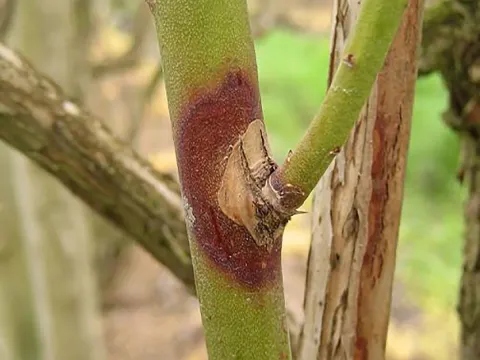
Godronia foliicola
Godronia foliicola
Godronia foliicola is an ascomycete fungus that acts as a specialized pathogen on various deciduous tree and shrub species. Classified within the Helotiales order, it is recognized as a significant agent of plant tissue decay.
What the section contains
Godronia foliicola
The life cycle of this fungus involves both asexual conidial stages, which facilitate rapid spread during the growing season, and sexual stages where apothecia develop on overwintered necrotic plant tissues.
The fungal mycelium penetrates deeply into the plant's vascular and cortical tissues. By secreting specific enzymes, the pathogen breaks down cellular structures, leading to the formation of localized necrotic lesions.
Correct identification often requires microscopic examination of the spores and fruit bodies. Because this species shares similarities with other fungi in the Godronia genus, professional diagnostic procedures are recommended.
Understanding the biological requirements of this fungus is essential for effective monitoring. Its adaptability to diverse moisture and temperature regimes makes it a resilient pathogen in various forest and nursery environments.
The primary hosts for Godronia foliicola are willow species (Salix). The fungus targets stems, branches, and leaves, causing substantial damage that compromises the plant's physiological integrity.
Infection typically results in the development of bark cankers. If a canker grows to surround the stem, it causes girdling, which effectively cuts off nutrient transport and leads to the death of the upper portion of the branch.
In commercial plantations, the presence of the pathogen results in reduced wood quality and biomass loss. Severe infections can destroy entire seedlings, leading to significant economic losses in nursery operations.
Beyond direct tissue destruction, the pathogen weakens the host plant, rendering it more susceptible to secondary stressors like drought, cold, or secondary pests that thrive on stressed tree specimens.
The aesthetic degradation caused by the disease is a major concern for ornamental plantings, as the presence of cankers and dying branches renders the trees unsuitable for landscaping purposes.
The infection process initiates in early spring, triggered by high humidity and warming temperatures that facilitate the germination of overwintered spores on plant debris.
Throughout the summer, the fungus spreads via conidia during periods of rain and high wind. Frequent rainfall events are often correlated with the most intense cycles of new infection outbreaks on young shoots.
Overwintering occurs primarily through mycelium embedded in infected branches and within resistant apothecia on fallen leaves. This survival strategy ensures the fungus persists in the environment for many years.
While extreme summer heat may temporarily slow fungal metabolic rates, the pathogen remains viable in shaded or humid areas of the canopy. Once environmental conditions stabilize, it resumes its damage cycle.
In late autumn, the fungus concentrates its energy on preparing for the dormant season. The maturation of reproductive structures during this period is critical for the long-term success of the pathogen on the host site.
The earliest symptom is the appearance of brown or reddish lesions on the foliage. These lesions may enlarge and merge, causing premature wilting, discoloration, and eventual leaf fall throughout the crown.
On woody stems, depressed cankers become visible. These areas often appear dark and sunken, and the surrounding bark may crack or split, sometimes accompanied by localized exudation of plant sap.
High humidity promotes the emergence of fungal fruiting bodies on the surface of the cankers. These appear as tiny dots, which are indicative of active sporulation and high potential for spreading the disease further.
- Browning and necrosis of leaf surfaces
- Depressed cankers and bark cracking on branches
- Premature senescence and leaf drop
- Withered, dying shoot tips (dieback)
In advanced stages of the disease, the affected branches become physically fragile and are prone to breaking under snow loads or during high winds, indicating deep-seated decay within the woody tissue.
Sanitation is the most effective management strategy. Pruning out infected branches is essential; it is critical to cut well below the visible symptoms to ensure all infected tissue is removed and destroyed.
Utilizing certified disease-free nursery stock is the first line of defense. Proper plant spacing is equally important, as it improves airflow and reduces the micro-humidity that the fungus requires to thrive.
Chemical control involving copper-based fungicides or systemic treatments can be applied preventatively in early spring before buds break. This minimizes the initial spore load on the plants.
Optimizing plant health through balanced nutrient management strengthens the host's natural defenses. Avoiding excessive nitrogen fertilization helps keep cell walls robust and less penetrable to fungal hyphae.
Disinfecting pruning tools between cuts on different plants prevents the accidental mechanical transmission of spores, which is a common cause of disease spread within crowded nursery or orchard environments.