
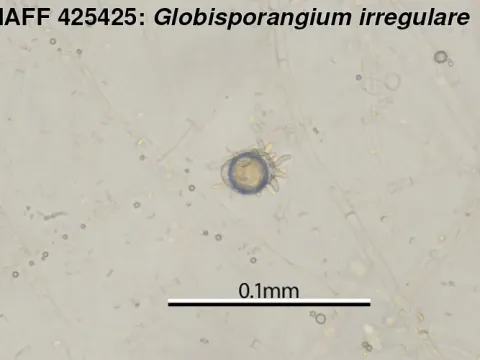
Globisporangium irregulare
Globisporangium irregulare
Globisporangium irregulare, formerly known as Pythium irregulare, is a widespread soil-borne oomycete pathogen. Although historically treated as a fungus, it belongs to the kingdom Chromista and is closely related to algae, sharing distinct biological characteristics.
What the section contains
Globisporangium irregulare
The pathogen is characterized by coenocytic (non-septate) hyphae that ramify through the soil and plant tissues. The species name reflects its diagnostic morphology, specifically the irregular, knotty shape of its oogonia and the presence of pleiogynous antheridia.
It thrives by producing motile zoospores, which are biflagellated spores capable of swimming through soil water toward the chemical exudates released by host roots. This mobility is a major factor in its rapid spread during irrigation.
Survival is ensured by thick-walled oospores, which are sexual spores that can remain dormant in the soil for several years. These spores are highly resistant to desiccation, temperature fluctuations, and most soil fungicides.
Identification often requires careful microscopic examination or molecular assays, as symptoms often mimic other Pythium or Phytophthora species, making visual diagnosis in the field insufficient for definitive identification.
This pathogen is a versatile necrotroph, infecting a vast range of host plants. It primarily attacks the root system, causing severe damping-off in seedlings and root rot in established plants.
Commonly affected crops include various greenhouse vegetables like cucumbers and peppers, as well as ornamentals, grains, and turfgrass. It is particularly devastating in nurseries where high plant density is maintained.
Infections cause the degradation of the cortical tissues of the roots. This effectively destroys the plant's ability to uptake water and nutrients, resulting in stunted growth, leaf chlorosis, and sudden wilting.
Seedling blight, often referred to as "black leg," is a hallmark of this pathogen. The stems become water-soaked and necrotic at the soil line, causing the plant to collapse and die within a few days.
The economic impact is substantial, involving not only the direct loss of plants but also the cost of replanting, loss of yield quality, and the necessity for intensive chemical intervention in high-value cropping systems.
Globisporangium irregulare is most active in moist, poorly drained soils. While it can persist in a variety of temperatures, it prefers moderate conditions, typically between 15°C and 25°C, for rapid infection and colonization.
In open fields, the disease is most prevalent in early spring when soils are cool and waterlogged from seasonal rains. High soil moisture creates the necessary conditions for zoospore movement.
In greenhouses, the season is effectively year-round. Over-irrigation, poor substrate aeration, and the introduction of infested soil or water are the primary triggers for disease outbreaks in controlled environments.
The pathogen completes its life cycle quickly when environmental conditions are favorable. Multiple generations of zoospores can be released, spreading the infection throughout the crop canopy or root zone.
As the season progresses or when conditions become unfavorable, the pathogen transitions to a survival phase, producing oospores that overwinter in the soil or in crop debris, ready to germinate when the next favorable season arrives.
The first symptoms are often non-specific. Growers might observe uneven stand emergence, where plants fail to sprout or die immediately after germination. Stunted plants with yellowing leaves are also common.
Root inspection is the most reliable way to spot the disease. Affected roots appear dark, mushy, and discolored. The outer cortex of the roots can be easily sloughed off, leaving the vascular cylinder exposed.
Wilting that occurs primarily during the hottest part of the day and temporary recovery at night is a classic sign of impaired root function. As the infection progresses, wilting becomes permanent.
In seedling trays, the disease often spreads in circular patches. Plants in these patches will die off sequentially as the zoospores move through the shared water supply in the trays.
In mature plants, the loss of lateral roots leads to a shallow root system, making the plant unstable. Even without total death, the reduced root mass significantly impacts crop productivity and tolerance to environmental stress.
Successful management of G. irregulare relies on an integrated approach, starting with high-quality, fungicide-treated seeds. Reducing the initial inoculum potential is the first line of defense.
Cultural practices are paramount, particularly managing water. Improving soil drainage, avoiding excessive irrigation, and ensuring that greenhouse substrates have high air-filled porosity significantly inhibit the pathogen.
Crop rotation is essential for long-term field management. Avoiding the cultivation of highly susceptible crops in infested fields for at least three seasons allows the population of oospores to decline significantly.
Chemical control involving fungicides specifically targeted at oomycetes (such as those containing metalaxyl, mefenoxam, or propamocarb) can be used as a drench or seed treatment in areas with a history of disease.
- Sterilize all pots, trays, and tools between uses
- Monitor and regulate irrigation water purity
- Use beneficial microbes to create a suppressive soil environment
- Promptly remove and destroy infected plant material