
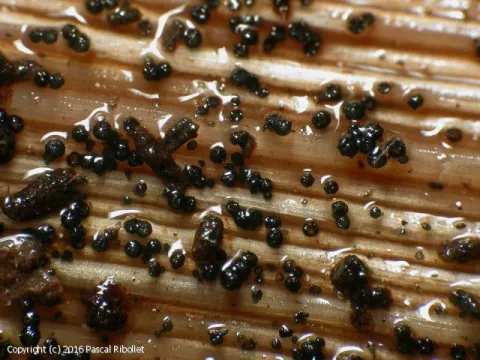
Gibberella cyanogena
Gibberella cyanogena
Gibberella cyanogena is an ascomycetous fungus belonging to the Nectriaceae family. It is a well-recognized soil-borne pathogen that plays a significant role in the development of plant diseases within various crop systems.
What the section contains
Gibberella cyanogena
The fungus exists primarily in an anamorphic state, closely related to the Fusarium oxysporum species complex, characterized by the production of microconidia and macroconidia. Under specific conditions, it forms perithecia as part of its sexual reproduction cycle.
It acts as a necrotrophic pathogen, secreting a variety of enzymes such as cellulases and pectinases to degrade plant tissues. The ability to produce mycotoxins, such as deoxynivalenol or zearalenone, makes this fungus a serious concern for food safety.
The fungus is highly adaptable, surviving in crop residues through thick-walled chlamydospores. These structures allow the pathogen to remain viable in the soil for several years, even in the absence of a host plant.
Laboratory identification often involves observing the characteristic colony morphology on agar media, typically showing white to pale pink mycelium, and microscopic analysis of the distinctive sickle-shaped macroconidia.
Gibberella cyanogena primarily attacks cereal crops including wheat, barley, and rye, causing severe damage such as head blight and seedling rot. It also affects a wide range of vegetables and tuber crops like potatoes.
Root rot caused by this pathogen leads to the blockage of vascular bundles in the plant. This restricts water and nutrient transport, leading to stunted growth, yellowing leaves, and often total plant collapse.
In the case of cereal crops, the fungus infects the heads, leading to withered, bleached spikelets. The grain quality is drastically reduced, appearing shriveled, discolored, and contaminated with fungal toxins.
For tuber crops, the fungus causes dry rot. This condition typically manifests during storage, resulting in sunken, wrinkled lesions and internal tissue necrosis that can destroy entire harvests.
The overall economic impact is significant, as it leads to both yield quantity loss and quality degradation, rendering the produce unsuitable for human consumption or animal feed due to mycotoxin contamination.
Infection cycles typically begin in early spring when the pathogen invades emerging seedlings from contaminated soil or infected seeds. Germination and colonization are favored by cool to moderate temperatures and high humidity.
The most critical window for head infection in cereals is the flowering stage. If rainfall occurs during this period, spores are splashed onto the heads, where they germinate and colonize the developing grain.
Throughout the growing season, the pathogen can spread through secondary infection cycles, especially when humidity remains high. Wind and rain are the primary vectors for dispersing macroconidia across the field.
Summer heat can occasionally suppress the pathogen's activity, but moisture availability remains the primary limiting factor for fungal growth. Drought stress in plants can also increase their susceptibility to infection.
By the end of the season, as plants mature, the fungus retreats into the stubble and plant debris. These residues serve as the primary reservoir for the following season's inoculum.
Early symptoms include brown necrotic lesions at the base of the stem and roots. In young seedlings, this often manifests as "damping off," where the plants fail to establish and wither shortly after emergence.
A hallmark sign on mature cereals is premature bleaching of the head. Affected areas of the head lose their green pigment and turn pale, contrasting sharply with the rest of the healthy plant.
In humid conditions, a visible fungal growth—white, pink, or orange, depending on the stage of sporulation—can be observed on the affected parts of the host plant, such as the base of the glumes.
When stems are split open, the internal tissues often reveal pinkish or brownish discoloration, indicating systemic mycelial colonization. Roots may appear stunted, darkened, and partially decayed.
In stored potatoes, signs include the development of external sunken areas. Under the skin, the flesh becomes dry, light-colored, and eventually turns into a powdery mass containing fungal spores.
Implementing a strict crop rotation strategy is the foundation of management. Avoiding cereal crops after susceptible predecessors like corn or wheat significantly reduces the primary inoculum level in the soil.
Effective tillage practices, such as burying crop residues deeply, help speed up decomposition. This reduces the survival time of the fungus in the field by eliminating its primary overwintering substrate.
Seed treatment with systemic fungicides is crucial to protect seedlings during the critical early development phase. This creates a protective barrier against soil-borne pathogens.
For head blight control in cereals, timely application of fungicides during the flowering stage is recommended, especially in regions with high precipitation. This prevents the colonization of the heads by fungal spores.
Selecting resistant or tolerant varieties is a long-term solution. Proper fertilization, particularly maintaining adequate phosphorus and potassium levels, helps strengthen plant health and natural resistance against the pathogen.