
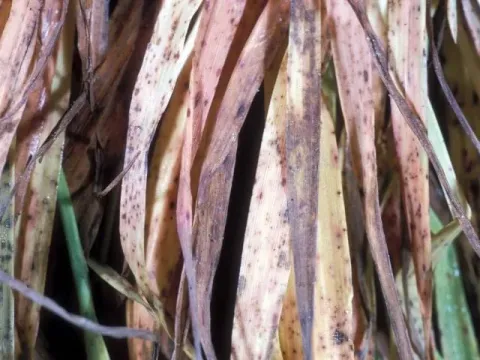
Oat leaf spot
Drechslera avenacea
The causative agent of the disease is the imperfect fungus Drechslera avenacea (synonym Helminthosporium avenae), which belongs to the kingdom Fungi, phylum Ascomycota. It is a specialized parasite that primarily infects oat crops.
What the section contains
Oat leaf spot
The fungus's mycelium develops within plant tissues, penetrating the epidermis and destroying parenchyma cells. Conidiophores emerge through stomata, forming an olive-black coating consisting of conidia that are spread by wind, rain, and insects.
The fungus is capable of surviving for long periods as mycelium and conidia on crop residues, in the soil, and within the seed material, making it extremely resilient to adverse environmental conditions.
The biological cycle includes primary infection from seeds or stubble, followed by secondary spread via conidia throughout the entire growing season of the crop.
For identification in laboratory conditions, microscopic examination of infected leaf areas is conducted to reveal characteristic multicellular spindle-shaped conidia with septa.
Oat leaf spot affects all aerial parts of the plant, including leaves, stems, sheaths, and panicles. The lower leaves are usually the first to suffer, as they have the most direct contact with the infectious background.
Damage to vegetative organs disrupts the photosynthesis process, which directly affects the accumulation of plant biomass. In cases of severe disease progression, premature drying of the leaf blade occurs.
Infection of the panicles causes browning and partial spikelet sterility. This leads to underdeveloped grains, reduced grain weight, and poor quality of the seed material.
The pathogen can cause systemic infection of seedlings, leading to reduced stand density and the death of young plants before they reach the tillering stage.
In years with epiphytotic development, grain yield losses can range from 15 to 30 percent, making this disease economically significant for oat-growing regions.
Primary infection occurs in early spring during seed germination, when the mycelium from the seed coat transfers to the coleoptile of the seedling.
Active development of the disease is observed during the tillering and jointing phases, especially under conditions of high air humidity and moderate temperatures ranging from +15 to +22 degrees Celsius.
Summer spread of conidia occurs during periods with frequent precipitation and high relative humidity (above 80%), which creates a favorable environment for spore germination.
Drought periods may temporarily halt pathogen development; however, upon the return of rain, the process of infecting new leaves resumes with renewed vigor.
Towards the end of the crop ripening season, the fungus enters a dormant state, accumulating on harvest residues and grain, serving as the main source of infection for the following year.
The first symptoms appear on seedlings as brown elongated stripes or streaks on the first and second leaves, often leading to their curling.
On adult plants, spots have the shape of elongated brown stripes, often surrounded by a yellowish chlorotic halo, which is a typical presentation of the disease.
Under high humidity, a velvety olive-black coating forms on the surface of the spots—this is the fungal sporulation, which serves as the primary diagnostic sign.
- Leaf striping progressing to necrosis.
- Browning and deformation of panicles.
- Stunted general growth of plants.
- Premature yellowing and death of leaves.
When seeds are infected, dark spots may be visible on them, which reduces the germination rate and vigor of the grain, creating a hidden source of disease.
The primary control method is the use of high-quality, treated seed material with systemic fungicides to suppress seed-borne infection.
Crop rotation is a mandatory requirement: returning oats to the same field no earlier than every 3-4 years significantly reduces the spore bank in the soil.
Deep incorporation of crop residues during plowing promotes their rapid decomposition and the death of the mycelium, which breaks the pathogen's development cycle.
Timely implementation of agronomic measures is important, such as applying optimal doses of mineral fertilizers, especially potassium, which increases plant resistance to fungal diseases.
When the threshold level of disease development is reached during the growing season, application of fungicides from the triazole or strobilurin groups is recommended.