
Oat crown rust
Puccinia coronata
Description
How to identify
The causative agent of this disease is the fungus Puccinia coronata, which belongs to the Basidiomycota division. It is an obligate parasite that requires specific conditions to survive.
The pathogen is heteroecious, meaning it requires two unrelated host species to complete its life cycle: oat (Avena sativa) and buckthorn (Rhamnus spp.).
The fungal mycelium colonizes the intracellular spaces of the leaf tissue, absorbing nutrients and interfering with the metabolic processes of the host plant.
It produces multiple spore types throughout its life cycle, including aeciospores, urediniospores, and teliospores, each serving a specific role in infection or survival.
Genetic diversity within the Puccinia coronata population allows the pathogen to evolve rapidly, often overcoming the resistance genes bred into new oat varieties.
What it damages
Oat crown rust primarily targets oat crops but can also infect various wild grasses, which act as secondary hosts or reservoirs for the fungus.
The damage is most severe on leaves and leaf sheaths, where the rust fungus limits photosynthesis, depriving the plant of the energy needed for grain development.
Severe infestations lead to premature leaf senescence, causing the plant to dry out much faster than normal during the critical grain-filling period.
Losses in yield are significant, ranging from 15% to 40% depending on the severity of the outbreak and the growth stage at which infection begins.
Grain quality is severely affected, resulting in low test weight, increased screenings, and poor seed viability, which impacts both commercial value and livestock feed quality.
When it appears
The disease cycle begins in early spring when aeciospores are released from buckthorn bushes and carried by the wind to young oat seedlings.
The epidemic phase occurs during the summer months when environmental conditions favor the rapid germination and production of urediniospores.
Favorable conditions for development include mild temperatures between 15°C and 22°C and high humidity, such as morning dew, fog, or frequent rain.
Each generation of urediniospores can complete its cycle in as little as one week, leading to rapid spread throughout the field during the mid-to-late growth stages.
As the oats reach maturity or as temperatures fluctuate toward the end of the season, the fungus produces teliospores to survive the winter on crop debris.
Signs of infestation
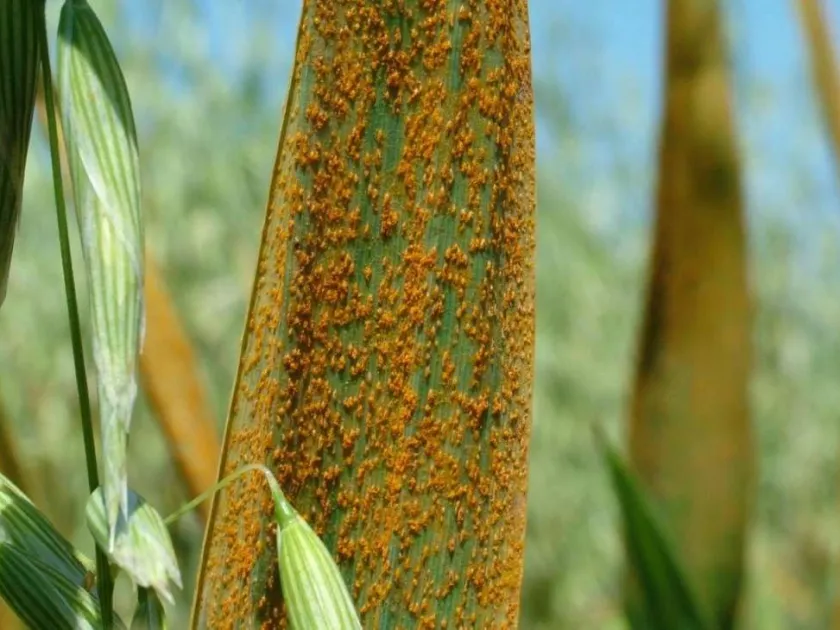
Symptoms are first visible as small, bright orange pustules (uredinia) scattered across the upper surface of the leaves.
These pustules contain mass amounts of spores that appear as orange dust when touched or disturbed by wind or farm equipment.
As the disease progresses, the pustules become more dense and may merge, eventually causing the surrounding leaf tissue to turn yellow (chlorosis).
In the final stages of the infection, the pustules turn dark brown or black, representing the transition to the teliospore stage, which is embedded under the leaf epidermis.
Fields with high levels of infection exhibit a stunted growth appearance and a distinct rust-colored tint that is easily identifiable during field scouting.
Control measures
The most effective strategy for managing oat crown rust is the planting of resistant or tolerant oat varieties that have been bred to withstand local races of the pathogen.
Eradication of buckthorn bushes within the vicinity of oat fields is essential to break the primary infection cycle of the fungus.
Crop rotation and the implementation of field hygiene help reduce the survival of the pathogen on crop residues and volunteers from previous seasons.
If thresholds are met, the application of effective fungicides, particularly those containing triazoles or strobilurins, can protect yield potential.
- Selecting high-quality seeds to ensure vigorous early growth.
- Avoiding excessive nitrogen fertilization, which can create a dense, humid canopy.
- Monitoring weather patterns to time fungicide applications precisely.
Causes diseases · 1
Discussion
No discussions yet — be the first.