
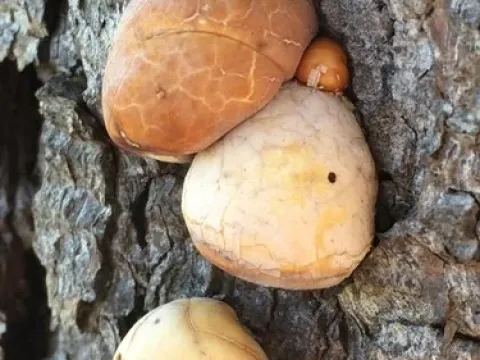
Cryptoporus volvatus
Cryptoporus volvatus
Cryptoporus volvatus is a unique basidiomycete fungus belonging to the Polyporaceae family. Unlike typical shelf fungi, it features a specialized enclosed fruiting body known as a volva, which protects its spore-producing surface until maturity.
What the section contains
Cryptoporus volvatus
This fungus primarily acts as a saprophyte that can occasionally exhibit weak parasitic behavior. While systematically related to the genus Polyporus, its distinct morphology is specifically adapted to facilitate dispersal through insect vectors.
The fruiting bodies appear directly on the bark of infected trees. They are generally solitary or found in small clusters, appearing as firm, smooth-surfaced structures ranging in color from cream to yellowish-brown.
A critical identifying feature is the opening at the base of the fruiting body. This pore allows spores to escape only after the internal environment has reached the optimal conditions for reproduction, ensuring efficient spread.
Identifying this fungus requires careful inspection of conifer trunks, as the fruiting bodies can be easily overlooked if they are partially hidden within bark crevices or if the observer is not looking for the specific "pouch-like" morphology.
The primary hosts of Cryptoporus volvatus are coniferous tree species, including various members of the Pinus (pine), Picea (spruce), and Abies (fir) genera. It typically colonizes trees that are already stressed, weakened, or dying due to other factors.
The fungus causes a specific type of brown rot within the wood. This process breaks down cellulose and lignin, significantly reducing the mechanical strength of the timber and increasing the risk of windthrow and structural failure in forest stands.
There is a strong ecological association between this fungus and wood-boring insects, particularly bark beetles. These insects act as vectors, transporting fungal spores into fresh entry points on stressed trees, effectively accelerating the infection process.
The damage caused by the fungus leads to the rapid degradation of wood, rendering it useless for commercial timber production and contributing to the ecological transition of the forest stand after disturbances.
In forest ecosystems, this fungus plays a dual role: while it is a wood-degrader, it also serves as an indicator of pre-existing pathology in the stand, marking trees that have been compromised by insect activity.
The life cycle of Cryptoporus volvatus is closely synchronized with the activity of its insect vectors. Spore production and the development of new fruiting bodies typically occur throughout the spring and summer months as temperatures rise.
The protective volva acts as a micro-environmental chamber, allowing the fungus to shield its spores from extreme fluctuations in humidity, which is vital for maintaining spore viability during dispersal.
Mycelial growth within the wood can continue throughout the year, provided temperatures remain above the threshold for metabolic activity. However, the production of visible fruiting bodies is most prolific during the warmer, wetter periods of the growing season.
The fungus exploits entry points created by boring insects. Once inside, it colonizes the sapwood, and as it matures, it prepares the bark surface for the eruption of new, closed fruiting bodies.
By the arrival of autumn, the cycle of active spore dissemination usually slows down, and old fruiting bodies may harden or decay, leaving the characteristic signs on the tree bark for future observation.
The most visible sign of infection is the presence of small, rounded or semi-spherical structures, roughly 2-5 cm in diameter, protruding from the trunk of a conifer.
The most diagnostic feature is the volva—a thin, leathery skin that covers the pores. When this membrane is intact, the fungus resembles a small, smooth pouch attached to the tree.
An opening at the bottom of the fruiting body indicates that the fungus is currently releasing spores. This is often accompanied by the presence of boring dust or frass from beetles near the site of infection.
When inspecting the interior of the wood, one would observe signs of brown rot, characterized by a brownish discoloration and brittle texture that often cracks in cubic patterns, typical of cellulose-decaying organisms.
The bark surrounding the fruiting body might appear slightly uplifted or distorted due to the pressure of the developing internal structures of the fungus beneath the outer layer of the wood.
The primary control strategy involves the implementation of sanitation logging. Removing infected, dying, and beetle-infested trees helps to reduce the inoculum load and prevents the spread of the fungus to neighboring healthy trees.
Managing populations of wood-boring insects is crucial, as they serve as the main vectors for the fungus. Integrating pest management practices, such as the use of pheromone traps, can significantly mitigate the risk of fungal spread.
Adherence to forest hygiene protocols, including the prompt removal of slash and windthrown timber, reduces the substrate availability for both the fungus and the insects that facilitate its colonization.
Regular monitoring of forest stands, particularly after events like droughts, wildfires, or storm damage, is essential for early detection and rapid response to emerging infection sites.
- Conducting timely sanitary thinning and selective logging.
- Removing trees infested with bark beetles.
- Minimizing the accumulation of logging residues and debris.
- Using pheromone-based monitoring and suppression of insect vectors.