
Cucumber downy mildew
Cucumber leaf
Description
How to identify
Downy mildew is caused by the oomycete Pseudoperonospora cubensis. Despite looking like a fungus, it is technically a water mold that thrives in humid environments.
The pathogen is an obligate parasite, meaning it requires living host tissue to complete its life cycle. It specifically targets plants within the Cucurbitaceae family.
The organism reproduces through zoospores that require free water on leaf surfaces to swim and infect new plant cells. High humidity is essential for its survival.
The pathogen overwinters as oospores in crop debris or survives in greenhouse environments on living tissue, making sanitation a critical component of disease management.
The development of Pseudoperonospora cubensis is highly temperature-dependent, with the most aggressive spread occurring between 16°C and 22°C in moist conditions.
What it damages
The disease causes significant damage to cucumber crops, leading to severe yield losses. It disrupts photosynthesis by killing leaf tissue, which prevents fruit development.
Affected plants become stunted, and the fruits often remain small, pale, and lose their marketability. In severe cases, the entire plant may die within weeks of infection.
Economic impact is high due to both reduced productivity and the increased costs associated with repeated fungicide applications to save the remainder of the crop.
Secondary infections are common because the weakened state of the plant makes it susceptible to opportunistic pathogens, such as bacterial spot and soft rots.
Without proper management, downy mildew can devastate an entire field or greenhouse operation in a very short amount of time during favorable weather conditions.
Signs of infestation
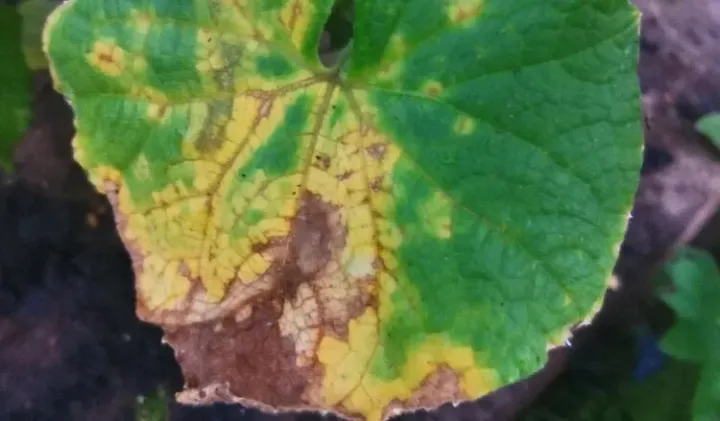
The first symptoms appear as yellow, angular spots on the upper surface of the leaves, confined by the leaf veins. This gives the infection a distinct mosaic pattern.
Under humid conditions, a greyish-purple fuzzy growth appears on the underside of these spots, which consists of masses of sporangia ready to release spores.
As the infection progresses, the yellow spots turn brown or necrotic, becoming brittle. The leaves eventually curl and die, moving from the bottom of the plant upwards.
While the necrosis is widespread, the tissue immediately adjacent to the main veins often stays green for a longer period compared to the rest of the leaf.
Rapid canopy collapse is a classic sign of this disease, where the foliage dries up and turns brown, drastically reducing the plant's ability to support further fruit set.
Control measures
Effective management begins with greenhouse climate control. Reducing relative humidity through proper ventilation and air circulation is the best way to prevent outbreaks.
Utilizing resistant cucumber varieties is the most sustainable approach. Breeding programs continue to focus on traits that hinder the pathogen's ability to colonize the host.
Chemical control includes using contact and systemic fungicides such as cymoxanil, metalaxyl, and copper-based products. Rotating these classes is necessary to prevent fungicide resistance.
Cultural practices are essential: avoid overhead irrigation that leaves water on foliage. Drip irrigation is highly recommended to keep the leaf canopy dry.
Sanitation is key; remove and destroy all infected plant material at the end of the season to eliminate the source of inoculum for the following year.
Causes diseases · 1
Discussion
No discussions yet — be the first.