
Cochliobolus miyabeanus
Cochliobolus miyabeanus
Cochliobolus miyabeanus is an ascomycete fungus that acts as a serious plant pathogen. Its asexual stage is recognized as Bipolaris oryzae, which is frequently encountered in agricultural fields.
What the section contains
Cochliobolus miyabeanus
It belongs to the order Pleosporales. This pathogen is known for its ability to survive as a saprophyte on plant debris when the host crop is not available, making it difficult to eradicate.
The fungus produces conidia that are easily dispersed by wind, rain, and irrigation water, leading to rapid spread throughout a rice field during the growing season.
The infection process involves the germination of spores on the leaf surface, followed by the formation of appressoria to penetrate the plant epidermis and invade internal tissues.
The development of the fungus is favored by warm and humid conditions, specifically temperatures between 25°C and 30°C and extended periods of leaf wetness or high humidity.
The primary host of this pathogen is rice (Oryza sativa). The resulting disease is widely referred to as brown spot of rice, a condition that occurs globally in major rice-growing regions.
The fungus attacks roots, coleoptiles, leaves, leaf sheaths, and panicles. Seed infection is particularly problematic as it introduces the pathogen into new fields via the seed supply.
Damage to the leaf tissue significantly reduces the photosynthetic efficiency of the plant, leading to stunted growth, reduced biomass, and lower grain yield.
Severe outbreaks can cause significant grain discoloration, poor filling of grains, and low milling quality, which drastically reduces the market value of the harvested rice.
Historically, this pathogen has been linked to major food security crises, including the Bengal Famine in 1943, where it was identified as one of the contributing factors to rice yield losses.
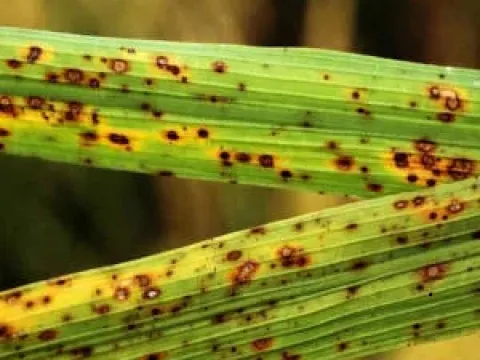
Symptoms initially appear as small, circular, or oval lesions on leaves. These lesions are typically brown or dark brown in color, sometimes with a yellowish halo.
As the disease progresses, the lesions enlarge and often exhibit a grayish center, giving them a distinct 'target' appearance in some varieties.
Under conditions of high moisture, a dense, dark brown to black velvety growth of conidia and conidiophores becomes visible on the surface of the lesions.
Infected panicles show dark, necrotic spots. When the infection occurs during the grain-filling stage, the seeds may become completely covered with black fungal mycelium.
The stems of the plants can also show signs of infection, characterized by dark brown lesions that can weaken the stalk and lead to premature lodging of the plants.
Integrated disease management (IDM) is essential for controlling Cochliobolus miyabeanus. It starts with the use of healthy, disease-free certified seeds.
Seed treatments with appropriate fungicides are highly effective in eliminating seed-borne inoculum and preventing early-season infection of seedlings.
Cultural practices such as field sanitation, proper weed control, and balanced nutrient management, particularly potassium application, help to increase plant resistance.
Fungicide applications during the vegetative and reproductive stages of rice growth are necessary when environmental conditions are conducive to disease outbreaks.
- Planting resistant or tolerant rice varieties.
- Ensuring proper drainage and avoiding excessive nitrogen fertilization.
- Burning or deep plowing of rice stubble to reduce inoculum load.
- Timely application of systemic fungicides like triazoles or strobilurins.