
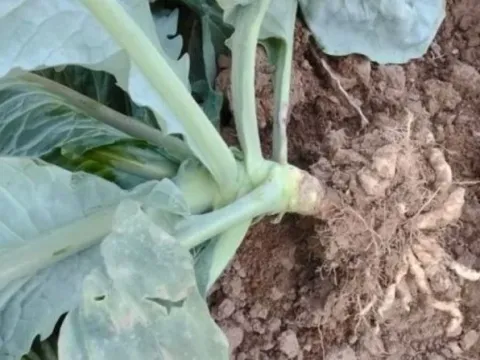
Clubroot
Plasmodiophora brassicae
The causative agent of clubroot is Plasmodiophora brassicae, an obligate intracellular protist classified under the phylum Plasmodiophoromycota. It specifically infects the root systems of plants belonging to the Brassicaceae (Cruciferae) family.
What the section contains
Clubroot
The pathogen functions by infecting the root hairs of the host plant, triggering abnormal cellular division and hypertrophy. This biological process leads to the formation of characteristic galls or clubs on the roots, which effectively inhibit the plant's nutrient uptake.
In the soil, the pathogen persists as resting spores (cysts), which are exceptionally resilient. These spores can remain viable for 7 to 10 years or more, even in the absence of a host crop, making long-term field management highly challenging.
The life cycle involves the release of motile zoospores that navigate through soil water to infect new roots. Once inside, the pathogen transforms into a plasmodium, consuming plant resources and driving the pathological growth of the root tissues.
Although historically grouped with fungi, Plasmodiophora brassicae is a specialized plant pathogen that requires distinct management practices compared to conventional fungal pathogens due to its unique biological structure and infection mechanism.
Clubroot causes severe damage to a wide range of economically important crops, including broccoli, cabbage, cauliflower, Brussels sprouts, kale, radishes, turnips, and various oilseed crops.
The primary damage results from the disruption of the vascular system in the roots. The galls restrict water and mineral movement from the soil to the leaves, leading to severe nutritional deficiency and stunted plant growth.
Affected plants often show wilting during peak daylight hours, reduced foliage development, and an inability to form marketable heads or roots. In severe cases, the plants may die before harvest.
The root galls also serve as entry points for secondary infections. Soft rot bacteria often colonize the decaying galls, resulting in complete destruction of the root system and total yield loss in heavily infested areas.
The pathogen drastically reduces field productivity, often forcing farmers to abandon cabbage production on infested lands or invest heavily in soil stabilization and specialized crop varieties.
Infection can occur throughout the growing season whenever soil moisture is adequate. Zoospore mobility is highest at soil temperatures ranging from 15 to 25 degrees Celsius (59–77°F).
Ideal conditions for the pathogen include high soil moisture levels, typically exceeding 75% of field capacity, and acidic soil conditions with a pH level between 5.0 and 6.5.
While extremely hot or dry weather can temporarily slow the progression of the disease, the resting spores remain dormant and viable, ready to resume activity once environmental conditions return to the pathogen's optimal range.
The pathogen is primarily spread through infested soil movement, including equipment, tools, water runoff, and, most importantly, the transplanting of infected seedlings from infested nurseries.
Seedling establishment is a critical window for infection; if the soil is contaminated at the time of planting, the young root system is highly susceptible to initial colonization, leading to severe disease pressure later.
Early symptoms include stunted growth and chlorosis (yellowing) of the leaves, which are particularly noticeable during the summer months. Plants frequently exhibit wilting during the day, recovering only at night.
When the plant is pulled from the soil, the diagnostic sign is the presence of swollen, club-shaped, or irregular galls on the roots. These galls vary in size and become progressively larger and darker over time.
Cross-sections of the galls usually reveal a pale, whitish, or cream-colored interior, which gradually turns brown or black as the tissue decomposes due to secondary rot organisms.
Early-stage infections in young seedlings can be subtle, requiring close inspection of the root system during the transplanting phase to ensure that no visible knots or thickenings are present.
- Wilting during sunny days
- Yellowing of lower leaves
- Abnormal root galls and swellings
- Severe reduction in crop yield
- Rotting and disintegration of the root system
Strict crop rotation is the cornerstone of management. Brassicaceous crops should not be planted in the same field more frequently than once every 5–7 years to allow for the natural decline of spore populations.
Soil liming is a vital cultural practice. Plasmodiophora brassicae is highly sensitive to alkaline environments; raising soil pH to 7.2 or higher using calcium-rich amendments can significantly suppress disease development.
Rigorous hygiene is essential to prevent introduction. Producers must ensure that seedlings are raised in pathogen-free soil and that all equipment is thoroughly cleaned before moving from an infested to a clean field.
Chemical treatments, such as applying fungicides in the planting hole, can provide temporary protection but are not a substitute for proper field sanitation and cultural management strategies.
The most effective long-term control strategy is the integration of resistant varieties. Plant breeders have developed several commercial cultivars with genetic resistance to specific strains of clubroot, providing a sustainable solution for infested fields.