
Cochliobolus heterostrophus
Cochliobolus heterostrophus
Cochliobolus heterostrophus is an ascomycete fungus and the causal agent of southern corn leaf blight (SCLB). In its anamorphic state, it is known as Bipolaris maydis. It is a significant threat to maize production globally.
What the section contains
Cochliobolus heterostrophus
The fungus produces hyphae that colonize host tissues and conidiophores bearing multicelled, curved conidia. These spores are highly adapted to wind and water dispersal, facilitating rapid spread across corn fields.
The sexual stage requires compatible mating types to produce pseudothecia. This genetic recombination allows the pathogen to evolve and develop new, more aggressive races, as historically demonstrated by the catastrophic T-race epidemic.
Taxonomically, it belongs to the family Pleosporaceae. It is a highly specialized pathogen that survives as mycelium or conidia in infested crop debris, soil, and infected seed lots throughout the winter months.
Its ability to produce host-specific toxins is a key mechanism of pathogenesis, leading to the rapid necrosis of host cells and facilitating the colonization of leaf tissue by the fungus.
The primary host of Cochliobolus heterostrophus is maize (Zea mays). The fungus attacks leaves, stalks, leaf sheaths, and ears, significantly reducing both grain yield and quality.
In addition to corn, the pathogen has a host range that includes various grasses and sorghum. These secondary hosts can serve as inoculum reservoirs when corn is not actively growing.
Yield losses result from the destruction of leaf tissue, which limits photosynthesis, as well as ear rot which ruins grain quality. Severe infections can lead to stalk lodging, making harvest operations difficult.
Grain harvested from heavily infected plants may be contaminated with fungal mycelium and secondary opportunistic mold, potentially harboring mycotoxins that are harmful to livestock and humans.
In susceptible hybrids, the disease can spread rapidly, leading to complete foliage loss before grain maturity, resulting in grain shriveling and reduced test weight.
The disease cycle begins when conidia from overwintering debris are spread to young corn plants by splashing rain or wind. This primary infection typically occurs in early summer.
Optimal environmental conditions for the fungus include high relative humidity (above 90%) and temperatures between 20°C and 30°C. Frequent rainfall is the most critical factor for epidemic development.
Once established, the pathogen undergoes a short incubation period, often as brief as a few days, followed by abundant conidia production on the lesions. This allows for repeated secondary cycles throughout the growing season.
The risk of infection is highest during the flowering and grain-filling stages. During this time, the dense canopy creates a microclimate with high humidity that favors the rapid multiplication of the pathogen.
As the crop reaches maturity or environmental conditions turn unfavorable (colder or drier), the fungus ceases active infection and shifts to a survival mode on plant debris, where it waits for the next season.
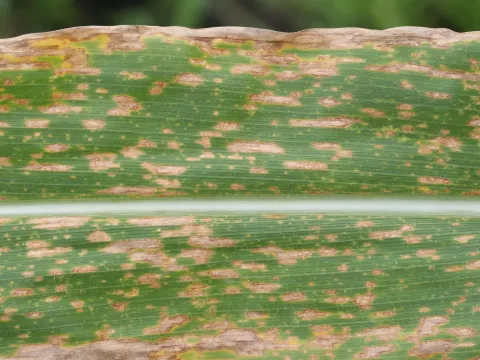
The hallmark of the disease is the development of elongated, spindle-shaped lesions on the leaves. These lesions are typically tan or brown with a dark center and a yellow-green halo.
Under humid conditions, a characteristic olive-colored, velvety layer of sporulation becomes visible on the surface of the lesions, particularly on the underside of the leaves.
As the infection progresses, individual lesions merge, causing large areas of the leaf to wither and die. This is often described as "blighting" or "firing" of the foliage.
Infected ears exhibit a dark, superficial mold growth on the husks and kernels. This growth can penetrate deep into the ear, causing the grains to become discolored and shriveled.
Stalk infection manifests as a decay of the pith, which weakens the plant and leads to lodging, especially during windy conditions or late in the season.
The primary control strategy for Cochliobolus heterostrophus is the use of resistant hybrids. Breeding for resistance has been the most successful approach to managing the disease in commercial agriculture.
Crop rotation away from corn for at least 2 years is highly effective in reducing the amount of primary inoculum present in the field by allowing residue to decompose.
Tillage practices that incorporate crop residues deep into the soil can help reduce the survival of the pathogen, although this may not be viable in no-till farming systems.
Fungicide applications are recommended in high-risk areas or during seasons with heavy, persistent rainfall. Products containing triazoles and strobilurins are typically effective.
- Planting certified, disease-free seed lots.
- Managing weeds that may serve as alternative hosts.
- Optimizing planting density to improve canopy airflow.
- Monitoring fields closely during the V8 to R3 development stages.