
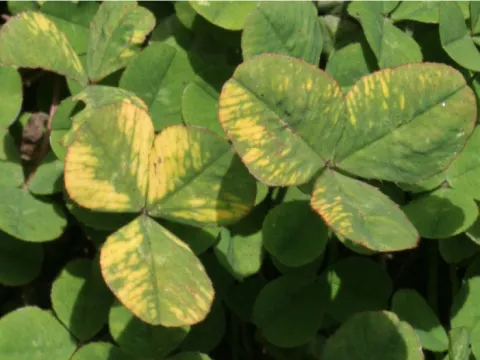
Clover yellow virus
Clover yellow
Clover yellow virus (CYV) is a plant pathogenic virus belonging to the Potyvirus genus, within the Potyviridae family. It consists of filamentous particles containing a single-stranded RNA genome.
What the section contains
Clover yellow virus
As an obligate parasite, this virus relies entirely on the host plant cells for replication, causing systemic infection by spreading throughout the vascular tissue of the plant.
The virus is primarily transmitted in a non-persistent manner by aphid vectors, such as the pea aphid, which acquire the virus while feeding on infected plant sap.
Mechanical transmission can also occur through contact with contaminated tools or equipment during farming operations, although this is secondary to insect-mediated spread.
Accurate identification is typically achieved through laboratory assays such as ELISA (Enzyme-Linked Immunosorbent Assay) or RT-PCR, as visual symptoms can often be confused with nutritional deficiencies.
Clover yellow virus affects a wide range of legumes (Fabaceae), including various clover species, alfalfa, and pea crops, causing significant agricultural concern.
The virus induces metabolic disruption, leading to reduced photosynthesis, stunted growth, and a significant decrease in green mass yield for fodder production.
Infected legumes exhibit weakened root systems, which makes them less resilient to adverse environmental conditions and more susceptible to secondary soil-borne pathogens.
The economic impact is particularly severe in perennial stands, where the virus accumulates over years, leading to progressive degeneration of the crop field.
Seed quality and overall plant vigor are drastically reduced, impacting the long-term sustainability of legumes in both pastures and cultivation fields.
Perennial legumes serve as the primary reservoir for the virus, allowing it to survive throughout the dormant winter period in the root and crown tissues.
The disease cycle intensifies in spring, coinciding with the migration of aphid populations that actively spread the virus to emerging foliage.
Warm and dry conditions during late spring and early summer often promote higher vector activity, leading to rapid disease dissemination across the field.
Visible symptoms typically peak during the mid-to-late growing season, especially when plants are under drought stress or during periods of rapid vegetative growth.
As the season ends, the virus migrates back to the root system, ensuring its survival and establishment for the following year's growth cycle.
The hallmark symptom of this infection is chlorosis, manifested as yellowing between the leaf veins, which can eventually cover the entire leaf surface.
Affected plants often display severe morphological changes, including deformed, wrinkled, or curled leaves that look significantly different from healthy foliage.
Stunting is a classic sign, where infected plants are considerably shorter and have a reduced number of leaves compared to healthy neighboring plants.
Flowering is usually inhibited or delayed, and if flowers do appear, they are often misshapen or produce fewer seeds of lower viability.
- Interveinal chlorosis (yellowing between veins)
- Leaf deformation, wrinkling, and curling
- Overall stunted growth and reduced vigor
- Reduced flowering and seed production
The most effective strategy for managing Clover yellow virus is the use of resistant crop varieties, which are bred to withstand viral infection.
Implementing spatial isolation between new legume seedings and established, potentially infected fields is critical to preventing early-season infection.
Strategic control of aphid vector populations using appropriate insecticides can help reduce the rate of virus transmission during critical growth stages.
Maintaining clean fields by removing weeds that can host the virus or act as a reservoir for aphids is a necessary component of an integrated pest management program.
Proper crop rotation practices and deep plowing to destroy infected plant debris at the end of the season are essential to break the virus life cycle.