
Clover mite
Clover mild
Description
How to identify
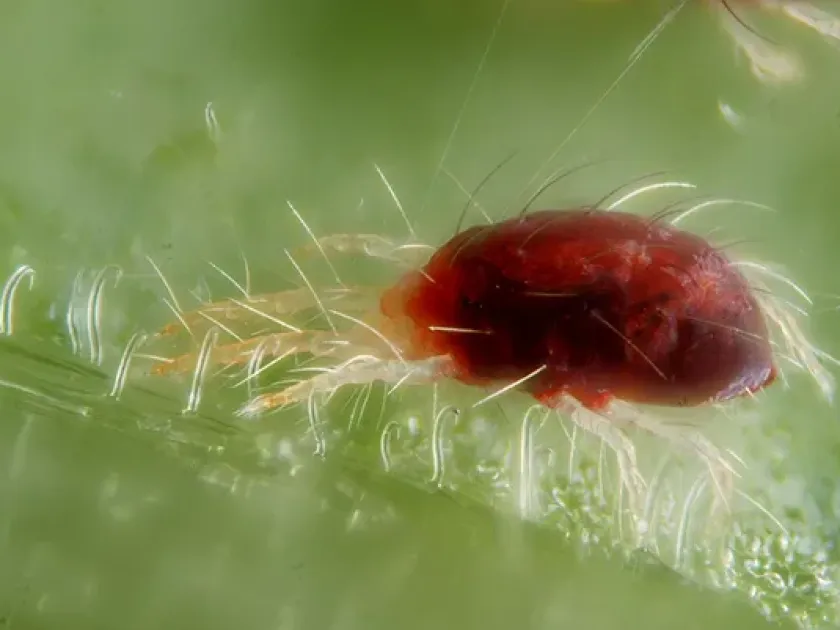
The clover mite (Bryobia praetiosa) is a common member of the spider mite family (Tetranychidae). Unlike most spider mites, this species is characterized by its front legs, which are significantly longer than the others and resemble antennae.
Adult clover mites are oval-shaped and reddish-brown in color, while the larvae are distinctly bright red. A key identification feature is that they do not spin webs, which distinguishes them from the more common two-spotted spider mite.
If crushed, they leave a noticeable red stain caused by the pigment in their hemolymph. This is a common way for homeowners to identify their presence on siding, windowsills, or sidewalks during migration periods.
The life cycle consists of the egg, larva, two nymphal stages, and the adult. They typically overwinter as eggs in crevices of tree bark, cracks in buildings, or at the base of host plants.
Activity commences in early spring as temperatures rise. After hatching, the larvae begin to feed on nearby plant material, eventually transitioning to their host plants to complete their development.
What it damages
Clover mites are polyphagous pests, feeding on hundreds of plant species, including lawn grasses, clover, vegetables, and ornamental trees. Young plants are particularly vulnerable during dry and warm seasons.
By piercing plant tissues and extracting sap, they cause a stippling or bronzing effect on leaves. This reduces the plant's photosynthetic capacity, leading to weakened growth and a dull, unhealthy appearance.
On ornamental and vegetable crops, severe infestations result in stunted growth and premature leaf drop. In orchards, excessive feeding can impact fruit set and reduce the tree's overall vigor for the following year.
Lawns infested with clover mites may develop large yellow or brownish patches. Because the mites are small, the damage is often attributed to drought or nutrient deficiency until the actual pest is identified.
While they do not feed on humans or animals, their habit of swarming in large numbers around houses in autumn makes them a significant nuisance pest for homeowners and landscapers.
When it appears
Clover mites are most active in early spring and late autumn. They thrive in dry conditions and prefer temperatures between 15°C and 25°C, making them especially prevalent in late spring.
During the heat of mid-summer, the population may enter a period of reduced activity or diapause. However, in irrigated landscapes or gardens, they can continue to reproduce throughout the entire growing season.
In autumn, as temperatures begin to cool, the mites undergo a migration phase, often moving in masses towards sheltered areas like the sunny sides of buildings, where they will spend the winter.
The speed of their lifecycle depends heavily on the ambient temperature. In warm conditions, multiple generations can occur in a single season, allowing populations to rebound quickly after minor disruptions.
Regular scouting is recommended from early spring through autumn. Focus on sunny walls, foundations, and the base of infested trees to detect early signs of a mounting population.
Signs of infestation
The primary symptom of an infestation is a characteristic silvery or pale stippling on the leaves. As feeding progresses, the leaf may take on a bronze or yellowish cast without any visible fungal structures.
Using a magnifying glass, you can often see the mites themselves moving across the leaf surface, along with their discarded translucent white skins (exuviae) left behind after molting.
Stunted growth, curled leaves, and early senescence are common markers of a heavy infestation. On lawns, look for discoloration that appears in irregular patches, especially near the foundation of buildings.
Another indicator is the presence of red smears on walls or windowsills, confirming that the mites are active in the immediate vicinity. This is often the first sign that alerts people to an ongoing problem.
It is important to distinguish clover mite damage from plant diseases. Unlike viral or fungal pathogens, mite damage does not feature necrotic spots with halos, spores, or mycelium growth.
Control measures
Effective control requires an integrated approach. The most important preventative step is to maintain a sterile, vegetation-free buffer zone (approximately 0.5 to 1 meter wide) around the foundation of buildings to block their movement.
Good cultural practices, such as proper watering and fertilizing, keep plants healthy and more resistant to mite feeding. Avoid over-fertilizing with nitrogen, which can lead to succulent growth that is highly attractive to mites.
Chemical control should rely on targeted acaricides. It is essential to rotate products with different modes of action to prevent the development of resistance within the population.
- Physical control: Spraying water to knock mites off plants or using soap-based detergents.
- Biological control: Encouraging natural predators like ladybugs, lacewings, and predatory mites.
- Chemical control: Applying specific acaricides during the peak egg-hatch periods.
In autumn, ensure that trees near buildings are trimmed to prevent mites from using them as bridges to reach the structure. Regularly removing weeds near foundation areas will also limit their breeding sites.
Causes diseases · 1
Discussion
No discussions yet — be the first.