
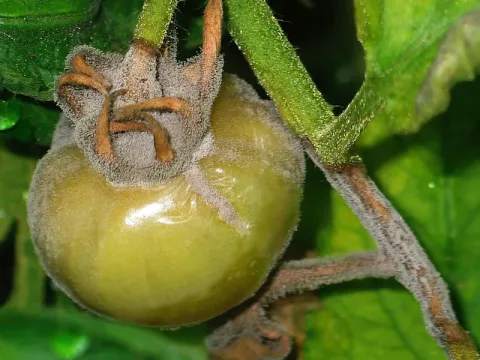
Gray mold
Botrytis cinerea
Gray mold is caused by the fungus Botrytis cinerea, an ubiquitous pathogen within the family Sclerotiniaceae. It is a necrotrophic fungus known for its aggressive ability to colonize a vast range of plant species.
What the section contains
Gray mold
The fungus produces masses of gray, fuzzy conidiophores and conidia on the surface of infected tissues. In adverse environmental conditions, it develops durable black structures called sclerotia, which act as primary inoculum.
Botrytis cinerea is capable of both sexual and asexual reproduction, and its teleomorph (sexual stage) is known as Botryotinia fuckeliana. This versatility allows the pathogen to adapt to various ecological niches.
The pathogen secretes cell wall-degrading enzymes and toxins that cause rapid tissue maceration and necrosis. This process allows the fungus to gain nutrients from dead or dying host cells.
Systematically, it is classified under the phylum Ascomycota. Its widespread distribution makes it one of the most economically significant pathogens in modern agriculture worldwide.
Gray mold affects a wide variety of crops, including strawberries, grapes, tomatoes, onions, lettuce, and numerous ornamental flowers. It targets almost all plant parts, including fruits, flowers, stems, and leaves.
In strawberries, the pathogen causes severe berry rot, rendering the fruit completely unmarketable within days. It is a major limiting factor for strawberry production in humid climates.
Viticulture is significantly impacted by bunch rot, which destroys clusters of grapes. This leads to substantial yield losses and can ruin the quality of wine due to the production of laccase enzyme.
Greenhouse crops, particularly tomatoes and cucumbers, often suffer from stem lesions that lead to plant collapse. This is particularly problematic in systems with poor ventilation and high humidity.
In post-harvest storage, gray mold acts as a destructive storage rot. It can spread quickly through contact between infected and healthy produce, leading to the contamination of entire batches.
Development is highly favored by moderate temperatures (15-25°C) and high humidity. Botrytis cinerea thrives in damp, overcast weather and requires free moisture for the germination of spores.
Infection cycles are frequent and can happen within a few days under optimal conditions. Rapid production of secondary spores ensures that the disease spreads quickly throughout the growing season.
Early spring infection usually begins from overwintering sclerotia located in the soil or on plant debris. These structures germinate to produce conidia that are disseminated by wind or splashing water.
The pathogen is particularly aggressive during periods of heavy dew or prolonged rainfall. High humidity levels inside greenhouses or tunnels can trigger massive outbreaks if not properly managed.
As the season progresses, the fungus may remain latent on senescing tissues or harvest wounds until favorable conditions trigger aggressive colonization.
The most recognizable sign is the fluffy, gray to brown fungal growth covering infected tissues. This growth consists of millions of microscopic spores ready for dispersal.
Infected areas initially show water-soaked spots that rapidly expand and turn brown or grayish. These spots eventually lead to soft, mushy decay of the affected organ.
Stem cankers often appear as elongated, necrotic lesions. If these lesions girdle the stem, it causes the wilting and death of the entire plant or branch above the infection point.
Flower petals may exhibit small, irregular, water-soaked lesions that quickly coalesce, leading to total blossom blight. This is common in ornamental crops like roses or lilies.
Small black, hard structures called sclerotia may be observed embedded within the rotted tissue or on the surface of the plant, serving as the resting stage of the fungus.
Sanitation is the cornerstone of control: removing and destroying infected plant debris reduces the primary inoculum for future seasons.
Improving airflow and reducing humidity are critical. Techniques include proper plant spacing, pruning, greenhouse ventilation, and using drip irrigation instead of overhead watering.
Fungicide applications are often necessary for commercial production. Commonly used groups include dicarboximides, anilinopyrimidines, and hydroxyanilides, applied preventatively or early in the infection stage.
Biological control agents, such as Trichoderma species or Bacillus subtilis, can be used to compete with the fungus and inhibit its colonization of plant tissues.
Post-harvest management involves careful handling to prevent wounds and maintaining cool storage temperatures to slow down the growth of the pathogen.